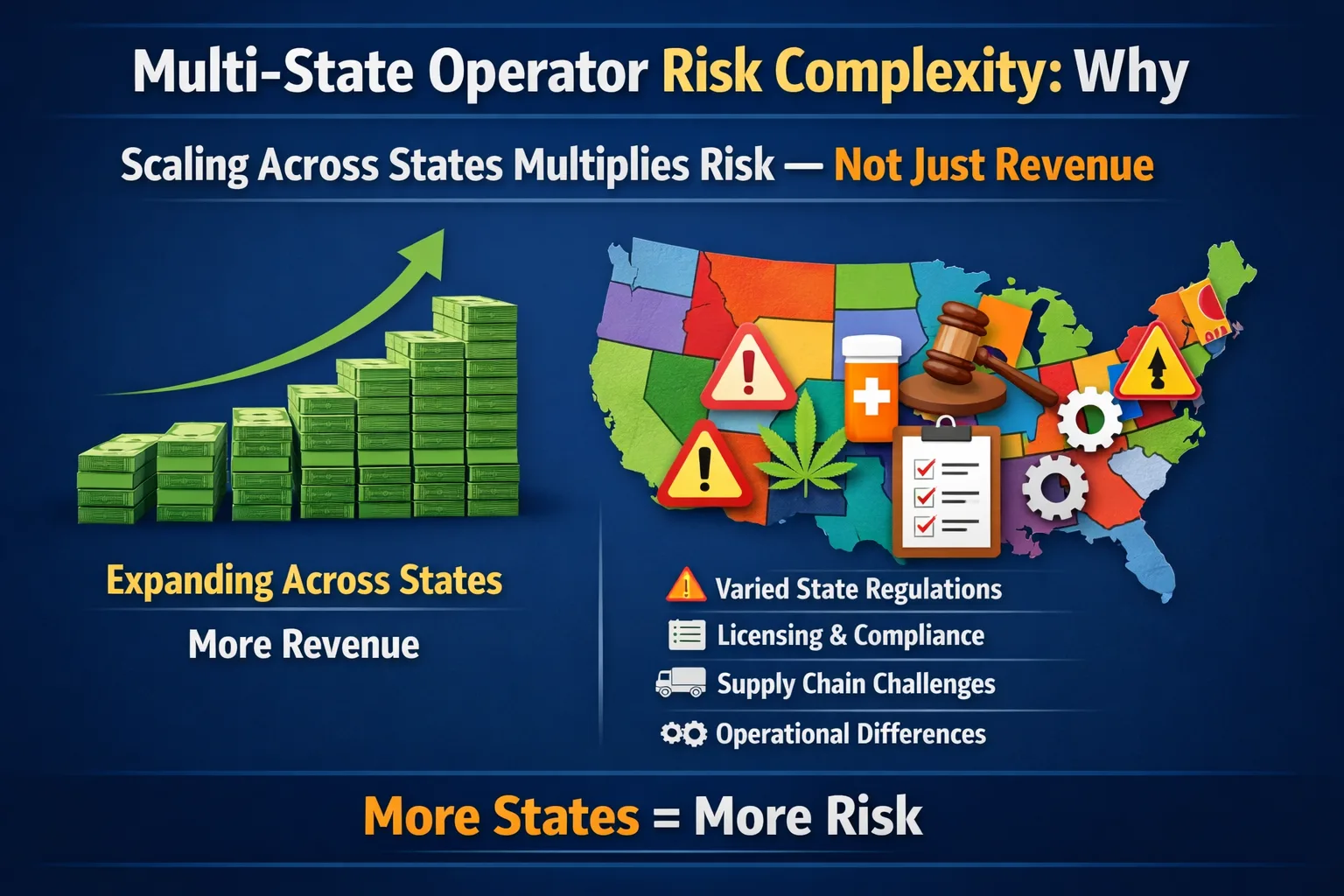
A cannabis company can look highly sophisticated from the outside and still be dangerously fragmented underneath. That is one of the most important risk truths in the multi-state operator world. More licenses, more dispensaries, more cultivation sites, and more branded products can create the appearance of maturity. Revenue grows. The org chart expands. Investors see footprint. Competitors see scale. But scale in cannabis often masks something else: uneven execution, conflicting state requirements, disconnected systems, inconsistent managers, and growing blind spots between what leadership believes is happening and what is actually happening on the ground. That is where losses begin. The core problem is not growth itself. The problem is growth without standardization. And in cannabis, that creates invisible risk layers. Bigger footprint, bigger exposure In theory, multi-state growth should create better purchasing leverage, broader brand reach, more diversified revenue, and stronger enterprise value. In practice, it also multiplies complexity in ways many operators underestimate. A single-state operator may struggle with compliance, safety, claims, and insurance. An MSO has to manage those same issues across multiple legal regimes, labor environments, licensing frameworks, testing rules, packaging standards, transport rules, and local enforcement cultures. Even public cannabis companies warn investors that U.S. cannabis laws, licensing rules, product testing, taxation, municipal restrictions, and operating requirements vary widely by state and locality. Some operators also specifically disclose that marketing, advertising, packaging, and labeling rules vary from state to state, limiting consistency and scale. (SEC) That is not just a legal observation. It is an operating reality.
Why MSO growth often creates a false sense of sophistication A company with operations in six or ten states may appear more mature than it really is. The danger is that leadership, lenders, insurers, and even the board can start assuming that a larger platform automatically means stronger controls. It does not. An MSO can still have: different onboarding processes by state different incident-reporting habits by location different inventory practices by facility different interpretations of SOPs by managers different claims-reporting timelines different local workarounds that never make it into enterprise reporting different HR practices that create EPLI exposure different maintenance standards that affect property and equipment losses different delivery and driver supervision standards that affect auto liability In other words, the company may have centralized branding and decentralized inconsistency. That is not scale. That is accumulated operational variance. State-by-state cannabis rules create real management friction Many MSOs talk about being “standardized,” but state law often limits how standardized they can actually be. That is especially true in cannabis, where core requirements differ across jurisdictions. California’s Department of Cannabis Control publishes separate final-form labeling checklists for manufactured and non-manufactured products, and requires products to be packaged and labeled for retail sale before transfer for compliance testing. California also warns that packaging and labeling that are attractive to children can trigger citations, fines, suspension, denial, or revocation. (cannabis.ca.gov) Oregon’s rules are changing again. Effective January 1, 2026, OLCC’s bulletin outlines updates affecting labeling, manifests and transfers, motion-activated camera systems, trade samples, producer and processor property-owner consent requirements, and retailer proximity-to-school
rules. In 2025, Oregon also dealt with labor peace agreement requirements for certain license types before a federal court ruling halted that requirement. (Oregon) Massachusetts issued multiple 2025 public health advisories tied to contaminated or potentially contaminated cannabis products. In one February 2025 advisory, products that had previously passed compliance testing were later found, after additional testing, to contain yeast and mold above acceptable limits. In an August 2025 advisory, the Commission said 544 lab samples had previously failed total yeast and mold testing, and noted that Metrc was used to help prevent further sales of affected products. (Cannabis Control Commission MA) None of this is theoretical. If you manufacture in one state, distribute in another, retail in several more, and attempt to run one brand standard over all of it, friction is inevitable. The mistake is assuming that this friction is just administrative. It is not. It is a direct source of loss exposure. SOP inconsistency is where “known risk” becomes actual loss Most MSOs have SOPs. That is not the same as having operational discipline. One cultivation site may follow sanitation protocols tightly. Another may document them poorly. One production facility may escalate deviations quickly. Another may normalize them. One retail chain may enforce ID checks, cash-handling rules, panic-button procedures, and inventory reconciliation with rigor. Another may treat them as suggestions. That gap matters. When SOPs drift across locations, a company starts to generate different risk profiles under the same logo. That leads to problems such as: 1. Higher injury frequency because lift procedures, PPE use, ergonomics, lockout/tagout, and training quality vary by site. 2. Higher products exposure because sanitation, testing holds, release protocols, or labeling verification are applied unevenly. 3. Higher theft and shrink because access controls, camera review, and inventory reconciliation are not handled consistently.
4. Higher employment risk because discipline, wage-and-hour practices, complaint escalation, and manager training differ across states. 5. Higher auto and transport risk because driver screening, routing, incident reporting, and vehicle inspection discipline vary by branch. This is how “we have a policy for that” turns into “why did this happen three times before anyone noticed?” Fragmented data systems hide recurring problems One of the biggest MSO failures is not the absence of data. It is the presence of too many disconnected versions of it. Many multi-state cannabis businesses still operate with a patchwork of: seed-to-sale systems local spreadsheets HR platforms safety logs claims reports state-specific compliance trackers maintenance systems accounting workarounds store-level dashboards manually prepared executive summaries When those systems do not speak to each other, management starts relying on lagging indicators and incomplete narratives. That creates several dangerous outcomes: the same type of product deviation appears in three states, but no one aggregates it workers’ compensation trends are tracked by broker or TPA, but not tied back to supervisor performance a delivery incident pattern is visible in telematics, but never makes it into quarterly risk review a retail shrink problem is treated as a local issue instead of an enterprise control failure a packaging or labeling problem keeps resurfacing because corrective actions are not being measured consistently In cannabis, this can be especially dangerous because regulators, insurers, investors, and counterparties tend to care less about whether a problem happened once than whether it suggests a pattern.
One location’s failure can become an enterprise problem quickly MSOs sometimes behave as if a bad outcome at one site can be contained as a local issue. That is often wishful thinking. In the cannabis space, a failure at one facility can spread across the enterprise in at least five ways: Regulatory scrutiny expands beyond the original site Brand damage spreads across markets sharing the same name Retail and wholesale trust erodes beyond the affected state Insurance underwriters start evaluating the entire platform differently Investors and lenders question control quality, not just the single incident This is especially true where common products, shared management, centralized procurement, or repeated procedures are involved. A contamination event in one state may trigger questions about sanitation, testing holds, supplier oversight, and release controls everywhere else. A labor or wage-and-hour problem in one market can prompt a broader review of manager quality and HR governance. A cargo theft or delivery crash can expose inconsistent transport protocols across the fleet. A cyber incident at one subsidiary can reveal weak enterprise-wide access controls. The legal entity structure may be fragmented. The reputational effect rarely is. A realistic MSO loss scenario Consider a hypothetical but very believable scenario. An MSO operates cultivation, manufacturing, and retail facilities across five states. Its central operations team believes packaging review is standardized. In reality, one state uses a legacy checklist, another relies on a local compliance lead, and a third has recently launched a new SKU approval workflow that has not been rolled out enterprise-wide. A labeling error slips through in one market. The affected product is sold through multiple stores before the issue is detected. A regulator intervenes. Product is quarantined. Distributors and retail partners ask questions. Social media
picks up the issue. Consumers start posting photos. A few stores in other states, carrying similar branding, receive complaints from customers who assume the issue is broader than it is. Now the company is dealing with: product withdrawal and disposal costs internal investigation expense possible consumer claims damaged retailer relationships management distraction reputational spillover underwriter concern at renewal board-level questions about governance The immediate operational issue may be local. The enterprise consequence is not. Another realistic scenario: workers’ compensation and management drift An MSO acquires three cultivation and manufacturing operations in rapid succession. At headquarters, leadership assumes all sites have harmonized safety training and return-to-work procedures. They have not. One site trains aggressively and reports incidents quickly. Another delays reporting, allows modified-duty confusion, and has supervisors who treat strains and repetitive-motion complaints as routine. A third location has weak forklift controls and uneven new-hire onboarding. Over 12 months, the company sees: preventable injuries inconsistent claim reporting delayed medical intervention poor return-to-work outcomes rising reserves worse loss development frustrated underwriters asking why a supposedly sophisticated operator has unstable site- level results The company does not have a workers’ compensation problem.
It has a management consistency problem that is expressing itself through workers’ compensation. That distinction matters. Insurance gets more complicated as the operating model gets messier Insurance becomes harder, not easier, when an MSO grows without control discipline. Here is why. Workers’ compensation Different hiring practices, training quality, supervisor habits, class-code usage, claim reporting speeds, return-to-work discipline, and medical-management practices can distort loss experience across states. One poorly run location can weaken the broader story you are trying to tell underwriters. EPLI Multi-state operators face different wage-and-hour rules, break requirements, leave laws, anti- discrimination frameworks, and manager behaviors. Uneven investigations, inconsistent discipline, and poor documentation multiply EPLI risk quickly. Commercial auto Delivery, inter-facility transport, armored or cash-related movement, routing, driver screening, telematics, MVR review, and post-accident protocols often vary more than leadership realizes. The result is avoidable auto frequency and ugly claims development. Property Different construction, catastrophe zones, maintenance quality, protective safeguards, alarm compliance, storage methods, and valuation discipline create inconsistent property profiles. One site may be under-protected, another underinsured, and another out of compliance with carrier conditions. Products liability and general liability State-specific packaging, labeling, testing, and release requirements make it harder to ensure that every product sold under one enterprise brand was produced and documented to the same standard. That is how coverage friction starts. Claim counsel and carriers will want to know exactly what was made, where, under which controls, and under what rules.
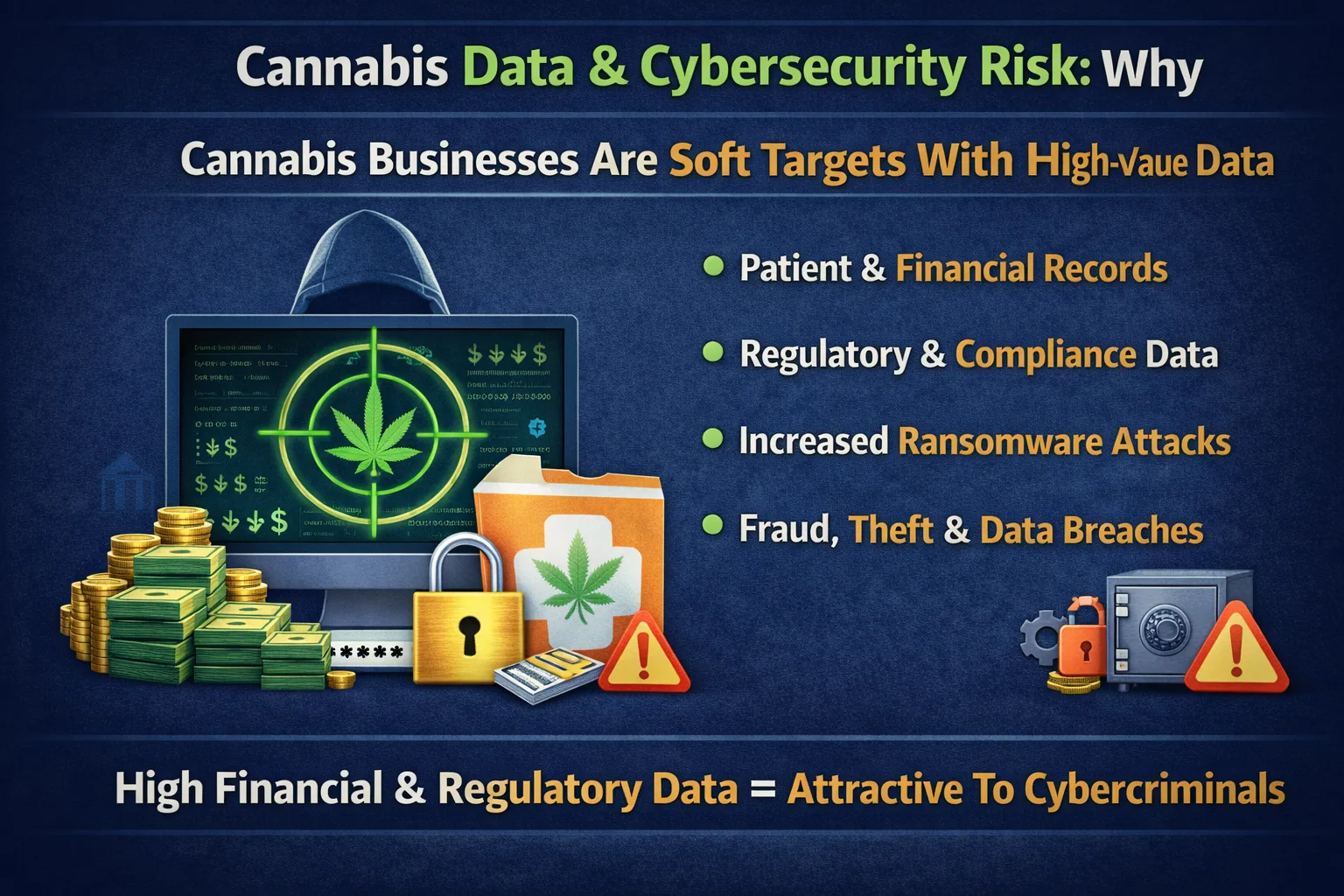
Cyber MSOs often have multiple access environments, legacy users from acquired entities, inconsistent permissions, and store-level workarounds. A company with fragmented systems may be carrying enterprise cyber exposure without enterprise cyber discipline. D&O When operations scale faster than governance, the D&O story changes. Investors care about more than topline growth. They care whether leadership knew about control failures, disclosed key risks accurately, and responded appropriately once problems surfaced. Insurance can transfer part of the financial consequence. It cannot fix fragmented operations. Why weak standardization can create coverage friction This is where many operators get surprised. They assume the policy is the backstop. Sometimes it is. Sometimes it is not. Poor standardization can create coverage friction in several ways: inaccurate or incomplete underwriting submissions inconsistent statements about controls across locations claim reporting delays unclear site responsibilities poor documentation of inspections, maintenance, training, or incident response product-traceability gaps inventory and chain-of-custody inconsistencies missed endorsements or state-specific coverage needs disputes over valuation, classification, scheduled locations, or covered operations The policy may still respond. But it may respond more slowly, less cleanly, and under more scrutiny than expected. That is not where you want to discover your operating model was never as standardized as your renewal narrative suggested. Current examples show why this matters Recent regulator activity underscores the point.
Massachusetts’ 2025 advisories show how products that were sold through retail channels after prior testing can later become the subject of contamination concerns, consumer advisories, and recall-style response activity. (Cannabis Control Commission MA) California’s Department of Cannabis Control continues to emphasize labeling requirements and restrictions around packaging attractive to children. California’s State Auditor reported in 2025 that 23 of 40 product packages reviewed were attractive to children in the auditor’s judgment, and also found inconsistency in how compliance history and packaging issues were documented and evaluated. (cannabis.ca.gov) Oregon’s 2025 and 2026 rule changes show how quickly operating expectations can shift on licensing, labeling, camera systems, manifests, trade samples, ownership documentation, and labor-related issues. (Oregon) For an MSO, these are not isolated state quirks. They are proof that regulatory drift, procedural drift, and execution drift can develop faster than leadership dashboards catch them. What stronger MSOs do differently The better-run MSOs do not confuse centralization with control. They build enterprise governance while preserving disciplined local execution. That usually includes the following: 1. One enterprise control framework They define which controls are non-negotiable across every site: incident reporting sanitation verification release protocols inventory reconciliation onboarding steps safety training minimums claims escalation supervisor documentation vendor standards camera and access-control expectations 2. State overlays, not state improvisation They do not let every market invent its own version of compliance. They use a core operating standard with state-specific overlays.
3. Common dashboards with common definitions They align metrics across locations so leadership can actually compare: injury rate near misses shrink product holds failed tests turnover claim lag delivery incidents audit scores training completion corrective-action closure 4. Manager accountability They do not assume site leaders will self-standardize. They audit manager behavior, documentation quality, and follow-through. 5. Cross-functional risk review They force compliance, operations, HR, finance, safety, legal, and insurance partners to review the same enterprise signals together. 6. Acquisition integration discipline They do not treat new locations as “plug and play.” They use structured post-acquisition control harmonization plans. 7. Strong claims culture They understand that claims are not just an insurance issue. Claims reveal where operations are weak, managers are uneven, and controls are failing. The investor and enterprise value angle This issue also matters far beyond day-to-day operations. MSO risk complexity affects: enterprise valuation diligence outcomes deal attractiveness
lender confidence board confidence executive credibility renewal leverage with carriers long-term insurability A platform with repeated local surprises is not demonstrating resilience. It is demonstrating weak visibility. Investors may forgive a bad quarter. They are less forgiving when the underlying issue appears to be unreliable controls across a supposedly mature enterprise. Final takeaway Cannabis MSO growth can create a dangerous illusion. The company looks larger. The map looks broader. The revenue story sounds stronger. But if the business is running on fragmented systems, uneven managers, inconsistent training, local workarounds, and state-specific improvisation, scale is not reducing risk. It is multiplying it. That is why standardization is not bureaucracy for its own sake. It is a core risk management discipline. In the cannabis industry, growth without standardization does not just create inefficiency. It creates invisible risk layers that eventually become visible through losses, claims, compliance failures, damaged enterprise value, and tougher insurance conversations. The strongest MSOs understand this early. The weaker ones learn it during a crisis.