Why Data Alone Doesn’t Reduce Risk—and What Leading Operators Are Doing Differently
AI in safety is not a future-state conversation. It is a competitive divide happening right now.
Cannabis operators are collecting more safety data than ever before. Near misses. Observations. Incident reports. Compliance logs. Audit trails. Training records.
On paper, that looks like progress.
In practice, much of that data never turns into action.
It sits in systems. It checks a box. It satisfies compliance.
But it does not prevent the next incident.
That gap—between data collection and real risk reduction—is where many cannabis businesses are losing control of safety outcomes and, ultimately, cost.
The Problem: Data Without Action
Most cannabis safety programs are built to capture information, not to drive decisions.
That creates a familiar pattern:
Incidents are documented after they occur
Trends are reviewed periodically
Reports are generated for compliance
Corrective actions are delayed or inconsistent
By the time a pattern is recognized, the loss has already happened.
In an industry where:
Workers’ compensation costs are rising
Regulatory expectations are increasing
Operations are tightly interconnected
…that delay matters.
A near miss that goes unaddressed today becomes a claim tomorrow.
Why Traditional Safety Programs Fall Behind
Traditional safety systems are reactive by design.
They rely on:
Historical reporting
Manual review cycles
Lagging indicators
Fragmented data sources
Even well-intentioned teams struggle to keep up because the process is slow.
And in cannabis environments—where cultivation, manufacturing, packaging, and distribution all overlap—risk does not wait for monthly reviews.
It develops in real time.
The Agitation: What the Market Is Already Doing
The broader safety landscape is shifting quickly:
84% of safety leaders are prioritizing AI
65% are already using predictive analytics
This is not experimentation. It is adoption.
Why?
Because organizations are realizing that:
Reactive systems miss early warning signs
Manual analysis cannot scale with data volume
Delayed decisions increase claim severity
In cannabis, that translates into:
Higher workers’ compensation costs
Increased regulatory scrutiny
Operational disruption across multiple functions
Leadership teams constantly reacting instead of planning
The Bigger Risk: Using AI Without a Foundation
Not every AI initiative improves safety.
In fact, many organizations create new problems by layering AI on top of weak systems.
Common issues include:
Poor data quality
Inconsistent reporting practices
Disconnected platforms
Lack of governance
No clear decision framework
This leads to what many operators experience as a “black box.”
Data goes in. Insights come out. But no one fully trusts or uses them.
That is not a safety strategy. It is noise.
The Shift: From Reporting to Real-Time Decision Making
Leading cannabis operators are approaching safety differently.
They are not using AI to replace safety teams. They are using it to enhance decision-making speed and accuracy.
Instead of asking, “What happened?” they are asking:
What is likely to happen next?
Where is risk building right now?
What action should be taken immediately?
This shift turns safety into a real-time decision engine.
What That Looks Like in Practice
Predicting Risk Before Incidents Occur
Patterns in near misses, behavior, and conditions are identified early—before they become claims.
Turning Data Into Immediate Action
Instead of static reports, operators receive prioritized insights tied to specific corrective actions.
Automating Compliance and Reporting
Audit-ready documentation is generated continuously, reducing administrative burden and improving consistency.
Creating Visibility Across Operations
Multi-state operators gain a unified view of risk across cultivation, manufacturing, and distribution.
Supporting, Not Replacing, Safety Teams
AI acts as a co-pilot—helping teams focus on high-impact decisions instead of manual data review.
Cannabis-Specific Impact
This shift matters more in cannabis because of operational complexity.
Consider a typical environment:
Cultivation teams working in wet, high-humidity zones
Packaging teams performing repetitive tasks
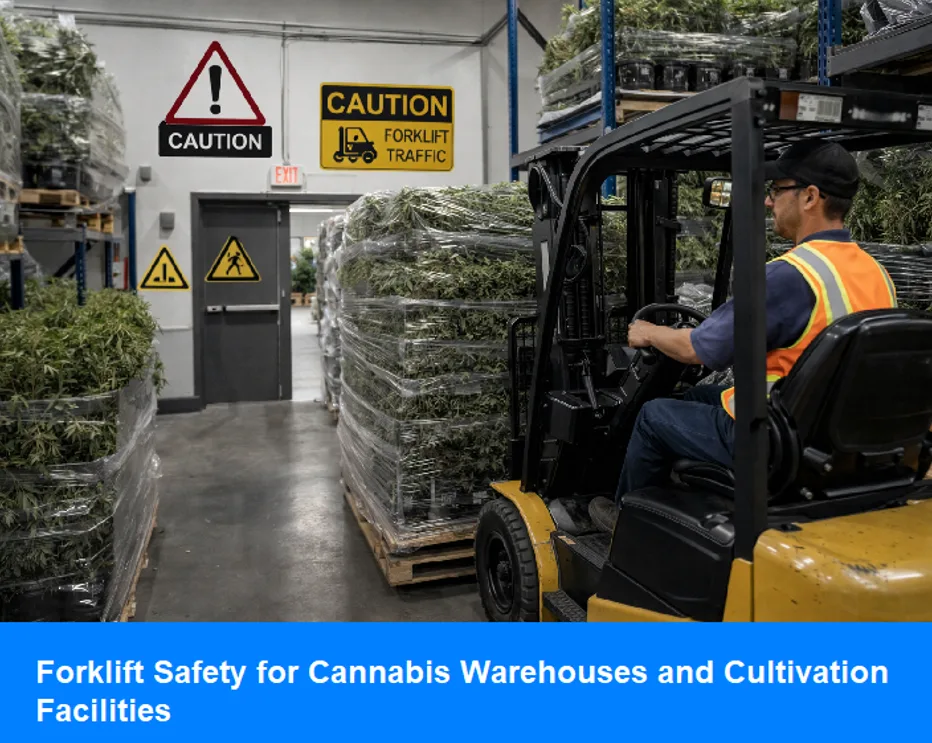
Warehouses managing inventory movement under time pressure
Mixed-experience workforce moving across functions
Risk develops quickly and often across departments.
Without real-time insight, issues stay hidden until they become:
Workers’ compensation claims
Product loss
Compliance violations
Operational disruption
AI-driven systems help surface these risks earlier—when they are still manageable.
Realistic Scenario
Multi-Facility Trend Detection Scenario
A cannabis operator tracks near-miss reports across multiple locations. Individually, the incidents seem minor.
However, when analyzed together, a pattern emerges:
Repeated slips in transitional areas between cultivation and storage
Similar timing across shifts
Consistent environmental conditions
A traditional system might identify this weeks later.
An AI-supported system flags the trend immediately, prompting:
Surface corrections
Workflow adjustments
Targeted communication
The result is simple: The incident that would have become a claim never happens.
Where Safety, Compliance, and Performance Converge
The most effective operators are not treating safety, compliance, and operations as separate functions.
They are aligning them.
When safety data drives decisions:
Compliance becomes easier to demonstrate
Operations become more predictable
Claims become less frequent and less severe
This is not just a safety improvement. It is a business performance advantage.
Common Weaknesses That Hold Operators Back
Many cannabis businesses struggle with:
Collecting data without analyzing it effectively
Treating compliance as the end goal
Delayed response to early warning signs
Overreliance on manual processes
Lack of integration across systems
These are not technology problems. They are execution and structure problems.
Why Execution Matters More Than Technology
AI does not improve safety on its own.
Action does.
The value of AI comes from:
Speed of insight
Clarity of recommendations
Consistency of execution
Without follow-through, even the best system becomes another unused tool.
CannabisRiskManager
For cannabis operators looking to move beyond reactive safety programs, structured implementation matters.
CannabisRiskManager works with cannabis businesses to operationalize AI across safety, risk, and compliance—ensuring that data:
Drives real decisions
Supports claim reduction
Holds up under regulatory scrutiny
The focus is not just on technology, but on building systems that actually work in real operations.
How AI-Driven Safety Improves Outcomes Over Time
When implemented correctly, operators often see:
Earlier risk detection
Fewer preventable incidents
Reduced workers’ compensation costs
Improved compliance posture
Better operational stability
In an industry where margins, regulation, and labor all create pressure, these improvements compound quickly.
Final Takeaway
Cannabis operators are not short on data. They are often short on actionable insight and execution.
AI is not the solution by itself. It is an accelerator.
The operators who will outperform the market are the ones who:
See risk earlier
Act with precision
Build systems that scale with growth and regulation
If safety data is not driving action, it is not an asset.