Leasing commercial property to a cannabis operator can be attractive.
Cannabis tenants often need specialized locations, invest heavily in buildouts, and may be willing to pay premium rents for properly zoned, compliant facilities. For landlords, that can create a meaningful income opportunity.
But cannabis occupancy is not ordinary commercial leasing.
A dispensary, indoor cultivator, manufacturing facility, edible kitchen, infused goods plant, distributor, or processing operation can materially change the building’s risk profile. The property may face increased electrical demand, humidity exposure, fire risk, theft exposure, regulatory scrutiny, security requirements, tenant improvement complexity, and coverage limitations that many standard landlord policies were never designed to address.
That is where Cannabis LRO insurance becomes critical.
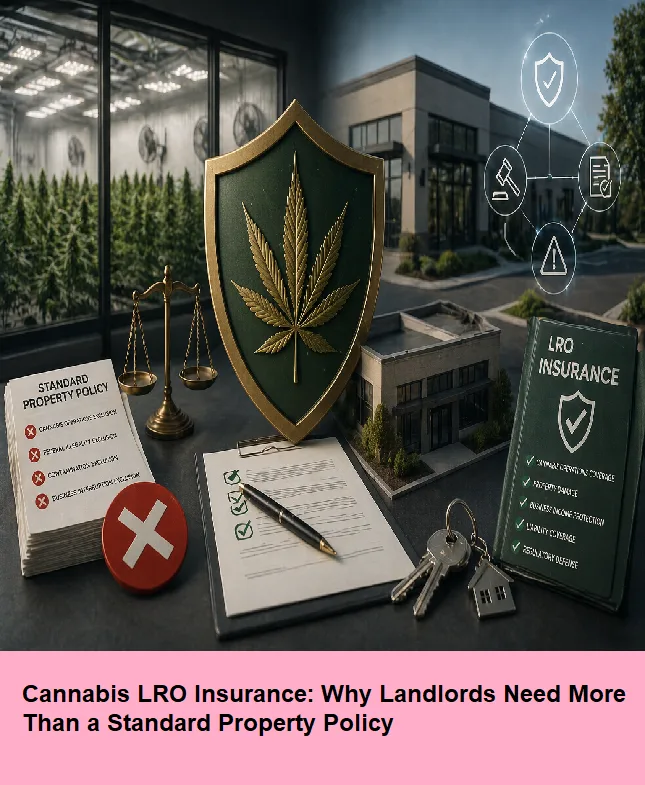
LRO stands for Lessor’s Risk Only. In plain language, it is insurance designed for property owners who lease buildings to tenants. But when the tenant is a cannabis-related business, the landlord needs more than a generic building policy and a certificate of insurance from the tenant.
The landlord needs an insurance program that understands the actual cannabis occupancy.
The most dangerous assumption is simple:
“I do not operate the cannabis business, so I do not have cannabis risk.”
That assumption can fail quickly after a fire, theft, water loss, mechanical breakdown, tenant default, regulatory shutdown, or injury claim.
What Is Cannabis LRO Insurance?
Cannabis LRO insurance is designed for landlords and property owners who lease commercial buildings to cannabis-related businesses.
This may include buildings occupied by:
Dispensaries
Indoor cultivators
Manufacturing facilities
Edible kitchens
Infused goods producers
Distribution facilities
Processing operations
Vertically integrated cannabis businesses
Hemp and cannabis-adjacent operators
At its core, Cannabis LRO coverage usually focuses on two broad areas.
Property Coverage
Property coverage protects the landlord’s building and, when properly structured, may include related exposures such as:
Building coverage
Business income
Loss of rent
Equipment breakdown
Tenant improvements
Contents owned by the landlord
Outside signs
Valuable papers
Replacement cost or actual cash value valuation
Other scheduled property interests
Commercial General Liability Coverage
Commercial general liability coverage helps protect the landlord from covered third-party claims arising out of ownership, maintenance, or use of the premises.
This may include claims involving:
Slip-and-fall injuries
Common area hazards
Unsafe premises allegations
Security-related allegations
Property damage to neighboring tenants
Certain premises-related bodily injury claims
The key issue is not whether the landlord has insurance.
The key issue is whether the policy properly contemplates cannabis occupancy.
Why Cannabis Tenants Create a Different Risk Profile
A cannabis tenant is not automatically a bad tenant. Many are sophisticated, compliant, well-capitalized, and professionally managed.
But the operations are different.
A traditional retail tenant may need basic lighting, shelving, HVAC, point-of-sale systems, and public access. A cannabis tenant may need vaults, cameras, enhanced security, odor control, specialized electrical systems, humidity control, commercial kitchen infrastructure, restricted access areas, safes, inventory tracking systems, chillers, dehumidification systems, backup generators, and regulatory-compliant storage.
For landlords, that raises important questions:
Did the tenant make electrical modifications?
Were all improvements permitted?
Who owns the tenant improvements?
Who owns tenant-installed mechanical equipment?
Who insures expensive mechanical systems?
Who maintains chillers, HVAC, generators, and co-generation equipment?
Does the landlord’s policy recognize the cannabis occupancy?
Is loss of rent covered if the tenant’s operation is shut down?
Are cannabis, controlled substance, or illegal activity exclusions present?
Are vacancy provisions a concern if the tenant fails or loses its license?
Does the lease require the tenant to maintain proper insurance?
Is the landlord named as an additional insured?
Are protective safeguards required by the policy?
Has the insurer been told what actually happens inside the building?
These are not academic issues.
They become real when there is a claim.
The Property Risks Cannabis Landlords Often Miss
Many cannabis landlord problems start with a simple misunderstanding:
The landlord thinks they are only insuring a building.
In reality, they may be insuring a building that has been physically transformed by a highly regulated tenant with specialized operational needs.
Tenant Improvements Can Create Coverage Confusion
Cannabis tenants frequently invest heavily in leased space.
Tenant improvements may include:
Vaults and secure rooms
Reinforced doors
Camera systems
Electrical upgrades
HVAC and air filtration
Odor mitigation systems
Commercial kitchen improvements
Grow rooms
Irrigation systems
Extraction or processing areas
Interior walls, counters, fixtures, and secure storage
The lease should clearly define who owns these improvements, who maintains them, and who insures them.
If the landlord expects the tenant to insure the improvements, the lease should say so clearly. If the landlord’s building limit includes tenant improvements, the values must be reflected accurately.
Otherwise, after a loss, both sides may discover that the improvements were underinsured, uninsured, or insured by the wrong party.
In cannabis, this is especially important because buildouts can be expensive, specialized, and difficult to repurpose for another tenant.
Tenant-Installed Mechanical Equipment May Be the Biggest Hidden Gap
One of the most overlooked Cannabis LRO issues involves expensive mechanical systems installed, owned, financed, or managed by the tenant.
In ordinary commercial leasing, tenant equipment may be relatively easy to separate from the landlord’s building. In cannabis, that line can become much harder to draw.
Cultivation, manufacturing, processing, extraction, and infused goods facilities often depend on major mechanical systems that can cost hundreds of thousands of dollars.
These may include:
Chillers
HVAC systems
Dehumidification systems
Air filtration and odor control systems
Boilers
Electrical switchgear
Backup generators
Co-generation systems
Fertigation and irrigation systems
Refrigeration or cold storage systems
Specialized manufacturing or processing equipment
These systems may be tenant-installed and tenant-managed, but they can become essential to the building’s use, the tenant’s ability to operate, and the landlord’s ability to collect rent.
That creates a major insurance and lease issue.
The landlord may assume:
“It is attached to my building, so my property policy covers it.”
The tenant may assume:
“It is part of the leased premises, so the landlord insures it.”
The carrier may say:
“This is tenant-owned equipment, not covered building property.”
That gap can become very expensive after a loss.
Why Mechanical Equipment Failure Can Become a Landlord Problem
A failed chiller, HVAC system, generator, or co-generation unit is not just an equipment problem.
In a cannabis facility, it can trigger a chain reaction.
A single mechanical failure may lead to:
Crop loss
Inventory damage
Mold or humidity damage
Smoke or fire damage
Electrical damage
Water damage
Production shutdown
Regulatory noncompliance
Tenant business interruption
Landlord loss of rent
Tenant default
Disputes over repair responsibility
Disputes over ownership of the damaged equipment
Claims involving contractors, vendors, lenders, and equipment finance companies
For landlords, the most important question is not simply whether equipment breakdown coverage exists.
The better question is:
Whose equipment is it, who is responsible for it, who insures it, and what happens if its failure damages the building or stops rent?
Scenario: Chiller Failure at an Indoor Cultivation Facility
Consider a landlord who leases a building to an indoor cannabis cultivator.
The tenant installs a $350,000 chiller and dehumidification system to control temperature and humidity inside the grow rooms. The equipment is critical to the tenant’s operation. Without it, the crop cannot survive, environmental conditions cannot be controlled, and the building cannot function as intended for that tenant.
Over a weekend, the chiller fails.
Temperatures rise. Humidity spikes. Mold develops in several rooms. The tenant loses a crop cycle and stops paying rent while operations are shut down.
The landlord submits a loss of rent claim.
The carrier begins asking difficult questions:
Who owned the chiller?
Was it part of the building?
Was it tenant business personal property?
Was it a tenant improvement?
Was it scheduled on either policy?
Did the landlord’s equipment breakdown coverage apply?
Did the tenant carry equipment breakdown coverage?
Was poor maintenance involved?
Were maintenance records available?
Was the equipment installed and permitted properly?
Was mold excluded or sublimited?
Was there covered direct physical damage to landlord-owned property?
Did the lease allow rent abatement?
Did the tenant’s failure to maintain the system contribute to the loss?
The landlord thought this was a simple business income or loss of rent issue.
In reality, it becomes a dispute over ownership, maintenance, policy language, equipment breakdown coverage, tenant improvements, mold limitations, and lease obligations.
Scenario: Co-Generation System Creates a Larger Loss
Now consider a cannabis manufacturer that installs a co-generation system to reduce utility costs and support high energy demand.
A mechanical or electrical failure causes a surge, damaging electrical panels, conduit, production areas, and portions of the building. The tenant cannot operate. Rent stops. The landlord faces repair costs, coverage questions, and potential delay in re-leasing the property.
Multiple policies may become involved:
Landlord property insurance
Landlord equipment breakdown coverage
Tenant property insurance
Tenant equipment breakdown coverage
Tenant commercial general liability
Contractor liability coverage
Business income coverage
Loss of rent coverage
Pollution or environmental coverage, depending on fuel, emissions, discharge, or contamination
The claim can become even more complicated if the equipment is leased, financed, subject to a lien, or maintained by a third-party vendor.
This is why tenant-installed mechanical systems should be addressed before the lease is signed, not after the claim.
What the Lease Should Say About Tenant-Installed Equipment
Cannabis landlords should require the lease to clearly address major mechanical systems and other high-value tenant-installed equipment.
At minimum, the lease should identify:
Who owns the equipment Is it landlord property, tenant property, a tenant improvement, leased equipment, or financed equipment?
Who is responsible for maintenance The tenant should be required to maintain critical systems according to manufacturer guidelines and provide documentation.
Who insures the equipment The lease should state whether the landlord or tenant is responsible for insuring repair or replacement.
How the equipment is classified for insurance purposes Is it building property, business personal property, tenant improvements and betterments, or scheduled equipment?
Whether equipment breakdown coverage is required Both landlord and tenant policies should be reviewed to determine whether equipment breakdown coverage applies.
What happens if the equipment fails and rent stops The lease should address whether rent abatement applies, when rent continues, and whether tenant failure to maintain equipment affects those rights.
What happens at the end of the lease Does the equipment stay, get removed, transfer to the landlord, or remain subject to a lender or equipment finance company?
Whether the landlord has inspection rights Landlords should have the right to inspect major mechanical systems and request maintenance records.
Whether alterations require approval Any major electrical, HVAC, chiller, generator, irrigation, or co-generation installation should require written landlord approval, permits, and licensed contractors.
Whether the landlord is protected from liens Financed or leased equipment can create lien and removal issues if the tenant defaults.
The goal is to avoid a situation where the landlord, tenant, carrier, contractor, and equipment lender all point at each other after a six-figure system fails.
Fire Risk Can Increase With the Occupancy
Cannabis occupancies can create increased fire exposure depending on the operation.
Indoor cultivation may involve high electrical loads, grow lights, irrigation systems, dehumidification, and HVAC demands. Manufacturing and infused product operations may involve ovens, cooking equipment, packaging machinery, solvents, oils, or specialized processing equipment.
Even when operations are compliant, the landlord should not assume the building’s original systems were designed for cannabis use.
Important questions include:
Has the electrical system been evaluated by a licensed professional?
Were permits obtained for tenant improvements?
Are fire suppression systems adequate for the current occupancy?
Is the tenant using any equipment or process that changes the hazard class?
Has the insurer been told exactly what the tenant does inside the space?
Has the insurer been told about major mechanical systems installed by the tenant?
A dispensary is not the same risk as a cultivation facility. A distribution facility is not the same risk as an extraction operation. A landlord policy should reflect the actual tenant use.
Humidity, Water, and Mold Can Become Serious Building Issues
Indoor cultivation and some processing environments can create moisture-related risk.
Excess humidity, poor ventilation, irrigation leaks, roof penetrations, condensation, and improperly installed HVAC systems can damage walls, ceilings, flooring, insulation, and structural components.
This matters because mold, moisture intrusion, and gradual deterioration are often heavily limited or excluded under property policies.
A landlord may assume damage to the building is covered because it is physical damage. The insurer may view it as long-term seepage, maintenance failure, faulty workmanship, faulty installation, or excluded mold-related damage.
The difference can be financially significant.
Vacancy and Tenant Failure Are Real Concerns
Cannabis operators face licensing risk, tax pressure, banking challenges, pricing compression, regulatory enforcement, and capital constraints.
If a tenant fails, abandons the space, loses its license, or enters bankruptcy, the landlord may face several problems at once:
Unpaid rent
Loss of rental income
Specialized buildout that is hard to re-lease
Cleanup costs
Damage to the premises
Security concerns
Unremoved equipment
Abandoned mechanical systems
Equipment liens or lender disputes
Regulatory complications
Insurance vacancy restrictions
Many property policies contain vacancy provisions that can reduce or eliminate coverage if a building is vacant beyond a certain period. Cannabis properties can be harder to re-tenant quickly because zoning, licensing, and buildout needs are so specific.
Loss of rent coverage should be reviewed carefully before a problem occurs.
Liability Risks for Cannabis Landlords
LRO coverage is not only about the building.
Landlords also face liability exposure arising from ownership, maintenance, and control of the premises.
Potential claims may involve:
Slip-and-fall injuries in common areas
Inadequate lighting or security allegations
Crime or assault in parking lots
Visitor injuries
Unsafe stairs, walkways, or entrances
Adjacent tenant complaints
Odor or nuisance allegations
Fire or water damage affecting neighboring units
Failure to maintain the premises
Disputes over responsibility for improvements, equipment, or repairs
Even if the cannabis tenant caused the problem, the landlord may still be named in a lawsuit.
That is why contractual risk transfer matters.
The tenant’s lease should require appropriate insurance, indemnification, additional insured status, waiver of subrogation where appropriate, and ongoing proof of coverage.
A certificate of insurance is not enough. The landlord or broker should review the actual coverage requirements and confirm that the tenant’s policy aligns with the lease.
Common Cannabis LRO Coverage Gaps
Cannabis LRO coverage can be valuable, but policy wording matters.
Landlords should not assume every landlord policy will respond the same way.
Below are some of the most important coverage issues to review.
Cannabis or Controlled Substance Exclusions
Some policies contain exclusions or limitations tied to cannabis, marijuana, controlled substances, illegal activity, or federally prohibited operations.
For a landlord leasing to a cannabis tenant, this can be dangerous.
The policy may appear to cover the building, but exclusions may create uncertainty if the loss is connected to the tenant’s cannabis operations.
A specialized Cannabis LRO policy should be reviewed for wording that directly addresses cannabis occupancy rather than avoiding it.
Designated Premises and Classification Limitations
Some liability policies limit coverage to specific premises, classifications, or operations.
That can create problems if the tenant’s operations change.
For example, a building originally insured as a retail dispensary location may later add delivery, manufacturing, packaging, distribution, or indoor cultivation activity. If the insurer was never informed, the policy may not match the real exposure.
Landlords should require tenants to disclose material operational changes before making them.
Loss of Rent and Business Income Issues
For landlords, one of the most important coverages is loss of rent.
If a covered property loss makes the building unusable, loss of rent coverage can help replace rental income during the restoration period.
But the coverage must be structured correctly.
Landlords should review:
The limit of insurance
The waiting period
The period of restoration
Whether cannabis occupancy creates any limitation
Whether tenant improvements affect restoration time
Whether tenant-installed mechanical systems affect restoration time
Whether ordinance or law upgrades may delay reopening
Whether tenant license issues could complicate re-occupancy
A building can be repaired faster than a cannabis business can be relicensed, repermitted, or operationally restored. That gap should be considered before a claim.
Tenant Improvements and Betterments
Tenant improvements are one of the most common sources of confusion.
The landlord, tenant, lender, and insurer may each assume someone else is responsible.
The lease and insurance program should answer:
Who owns the improvements during the lease?
Who owns them after lease termination?
Who insures them?
Are they included in the building limit?
Are they covered under the tenant’s property policy?
What happens if the tenant abandons them?
What happens if a loss damages only improvements but not the original structure?
This is especially important in cannabis because buildouts can be expensive and highly specialized.
Equipment Breakdown
Equipment breakdown coverage can be critically important in cannabis real estate.
Cannabis occupancies often depend on equipment that affects the building and tenant operations. This may include HVAC systems, electrical panels, refrigeration, commercial kitchen equipment, extraction-related systems, air filtration, chillers, dehumidification systems, and other mechanical infrastructure.
But landlords should not simply ask whether equipment breakdown coverage exists.
They should ask whether it applies to the specific equipment that matters.
A landlord’s equipment breakdown coverage may respond to certain landlord-owned building systems. It may not automatically cover tenant-owned equipment, tenant-financed systems, or specialized machinery installed for the tenant’s operations.
That distinction matters.
If a tenant-owned chiller fails and causes the tenant to shut down, the landlord may lose rent even if the landlord does not own the chiller. If a tenant-installed co-generation system causes electrical damage to the building, the landlord may face a repair claim, a liability dispute, and a loss of rent claim at the same time.
Equipment breakdown should be reviewed in connection with:
Building coverage
Tenant improvements
Business personal property
Loss of rent
Business income
Lease obligations
Maintenance requirements
Ownership documents
Equipment schedules
Vendor contracts
Contractor warranties
In Cannabis LRO, equipment breakdown is not just a coverage box to check. It is a major part of the property owner’s risk analysis.
Protective Safeguards and Security Requirements
Cannabis properties often require enhanced security.
Insurers may require alarms, cameras, central station monitoring, sprinkler systems, safes, vaults, locked storage, or other protective safeguards.
If a policy includes a protective safeguards endorsement, failure to maintain required safeguards can create claim problems.
For landlords, this creates a practical issue: the tenant may control day-to-day security, but the landlord may suffer the insurance consequence if safeguards are not maintained.
The lease should require the tenant to maintain all security systems required by law, lease, and insurance.
A Realistic Cannabis LRO Claim Scenario
Consider a landlord who leases a commercial building to a licensed cannabis manufacturer producing infused products.
The tenant installs additional electrical equipment, commercial ovens, packaging machinery, air filtration systems, and a tenant-managed mechanical system supporting temperature control and production. Some improvements are permitted. Some are not fully documented. The lease requires the tenant to carry property and liability insurance, but the landlord has not reviewed the tenant’s policy in two years.
A mechanical failure causes electrical damage and smoke damage after hours.
The fire is contained, but smoke damages the interior, equipment, walls, and ceiling. The tenant cannot operate. Rent payments stop. The landlord submits a building and loss of rent claim.
The carrier begins asking difficult questions:
What was the tenant’s exact operation?
Were the electrical upgrades disclosed?
Were improvements permitted?
Who owned the damaged improvements?
Who owned the mechanical equipment?
Was the failed equipment scheduled on either policy?
Was it landlord property, tenant property, or tenant improvement?
Were maintenance records available?
Were protective safeguards maintained?
Is the space properly classified?
Is loss of rent triggered?
Does any cannabis-related exclusion apply?
Was the building underinsured based on the actual buildout?
The landlord thought the issue was simple: damage to a leased building.
In reality, the claim becomes a coverage, valuation, lease, documentation, equipment ownership, maintenance, and tenant operations dispute.
This is why Cannabis LRO coverage must be structured before the loss.
What Better-Run Cannabis Landlords Do Differently
Sophisticated landlords do not treat cannabis tenants casually.
They manage the relationship with the same discipline they would apply to any specialized high-hazard occupancy.
They Disclose the Actual Cannabis Occupancy
The insurer should know what the tenant actually does.
A landlord should not describe a tenant as “retail” if the tenant also manufactures, distributes, stores inventory, delivers products, performs processing activities, or operates specialized mechanical systems that materially affect the building.
Accurate underwriting is better than a claim dispute.
They Require Strong Tenant Insurance
The lease should require the tenant to carry appropriate insurance, which may include:
Commercial general liability
Products liability, if applicable
Property coverage for tenant improvements, contents, inventory, and equipment
Equipment breakdown coverage
Workers’ compensation
Auto coverage, if delivery or transportation is involved
Umbrella or excess liability
Pollution or environmental coverage, where appropriate
Cyber coverage, where relevant
Business income coverage
The landlord should be named as an additional insured on the tenant’s liability policy where appropriate.
They Review Certificates and Endorsements
A certificate of insurance is not the policy.
Landlords should confirm:
Policy limits
Effective dates
Additional insured wording
Waiver of subrogation
Cancellation notice provisions
Cannabis-related exclusions
Products/completed operations where needed
Correct named insured
Correct premises address
Coverage for the tenant’s actual operations
Coverage for tenant-installed equipment
Equipment breakdown coverage, where required
This review should happen annually and whenever the tenant’s operation changes.
They Control Tenant Improvements and Mechanical Installations
The lease should prohibit unauthorized improvements and require landlord approval before material changes are made.
For cannabis tenants, this is especially important for:
Electrical work
HVAC changes
Chillers
Dehumidification systems
Backup generators
Co-generation systems
Plumbing
Irrigation systems
Roof penetrations
Extraction or manufacturing equipment
Kitchen equipment
Fire suppression changes
Security system modifications
Structural alterations
Landlords should require permits, licensed contractors, manufacturer specifications, maintenance obligations, and documentation.
They Inspect the Property
Landlords should reserve inspection rights in the lease and use them.
Inspection frequency should reflect the tenant’s operations. An indoor cultivation facility may require more frequent review than a simple administrative office. A manufacturing or infused goods operation may require different attention than a retail-only dispensary.
Inspections should focus on:
Unauthorized alterations
Water intrusion
Electrical conditions
Mechanical equipment condition
Maintenance records
Housekeeping
Fire protection
Security systems
Access control
Storage practices
Common area hazards
Signs of abandonment or distress
Documentation matters.
If a loss occurs, inspection records can help show that the landlord acted responsibly.
They Match Coverage to the Lease
The insurance program and lease should work together.
Too often, leases require one thing while the insurance program says another.
For example:
The lease may require the tenant to insure improvements, but the landlord’s building value may also include them.
The lease may require the tenant to maintain security, but the landlord’s policy may contain protective safeguard conditions.
The lease may shift maintenance responsibility to the tenant, but the landlord may still face liability as property owner.
The lease may require loss of rent protection, but the landlord may not carry enough rental income coverage.
The lease may say the tenant owns a chiller, but the landlord may depend on that chiller to preserve rental income.
The lease may require the tenant to maintain mechanical systems, but may not require maintenance records, service contracts, or proof of insurance.
Insurance should not be an afterthought to the lease.
It should be built into the lease strategy.
Practical Cannabis LRO Risk Management Checklist
Landlords leasing to cannabis tenants should review the following.
Tenant Operations
What does the tenant actually do at the premises?
Retail, cultivation, manufacturing, distribution, processing, delivery, or mixed use?
Has the tenant changed operations since the policy was placed?
Has the tenant added new equipment, processes, or product lines?
Lease Insurance Requirements
Are required limits adequate?
Is the landlord named as additional insured?
Are tenant improvements addressed?
Are major mechanical systems addressed?
Are indemnity provisions clear?
Does the lease require equipment breakdown coverage?
Does the lease require business income coverage?
Property Coverage
Is the building value accurate?
Are tenant improvements included or excluded?
Is loss of rent coverage adequate?
Is equipment breakdown included?
Are ordinance or law exposures addressed?
Are chillers, HVAC, generators, or co-generation systems properly classified?
Policy Exclusions
Are cannabis exclusions present?
Are controlled substance exclusions present?
Are vacancy restrictions understood?
Are protective safeguards required?
Are mold, pollution, or contamination exclusions relevant?
Are mechanical breakdown, wear and tear, or maintenance-related exclusions relevant?
Tenant Improvements and Equipment
Were improvements approved?
Were permits obtained?
Who owns them?
Who insures them?
Are values documented?
Are major mechanical systems scheduled?
Are maintenance records required?
Are equipment warranties transferable?
Are financed systems subject to lender rights?
Security and Compliance
Are alarms, cameras, safes, vaults, and access controls maintained?
Does the tenant comply with state and local cannabis rules?
Are security responsibilities clearly assigned?
Does the insurance policy require specific safeguards?
Ongoing Review
Are COIs collected annually?
Are endorsements reviewed?
Are operations checked for changes?
Are inspections documented?
Are equipment maintenance records reviewed?
Are lease requirements aligned with the insurance program?
Why This Matters for Property Owners
Cannabis real estate can be profitable, but it is not passive in the same way as ordinary commercial leasing.
The landlord’s risk is tied to the tenant’s operations, the lease structure, the building condition, the quality of tenant improvements, the condition of tenant-installed equipment, and the insurance wording.
A strong Cannabis LRO program can help protect:
The building
Rental income
Tenant improvement investment
Liability exposure
Long-term property value
Lender relationships
The landlord’s balance sheet
But the policy must be designed for the real exposure.
The most dangerous assumption is that a standard landlord policy will respond cleanly simply because the landlord does not personally operate the cannabis business.
In a claim, the building’s occupancy matters.
So does the equipment the building depends on.
Final Takeaway
Cannabis landlords need insurance programs built around the tenant’s actual operations, not generic property assumptions.
A well-structured Cannabis LRO policy should be paired with a strong lease, clear insurance requirements, proper tenant improvement controls, accurate underwriting information, equipment breakdown review, maintenance obligations, and annual coverage review.
The landlord does not need to run the cannabis business to be exposed to cannabis-related risk.
They only need to own the building where the risk occurs.
And if the building’s rental income depends on tenant-installed chillers, HVAC systems, generators, co-generation equipment, or other six-figure mechanical systems, those exposures need to be addressed before the claim — not after.