In cannabis, workplace injuries are often treated like isolated incidents: one employee tweaks a back while moving product, another slips in a wet hallway, another develops wrist pain after months in trim. But when you step back and look at the pattern, most of these losses are not random at all. They are operational signals. They point to flawed workflows, weak supervision, poor workstation design, inconsistent housekeeping, or production environments that ask too much from the body without enough discipline around safety.
That matters because workplace injuries are not just a safety problem. They are a cost problem, a staffing problem, a training problem, and an insurance problem. A handful of preventable claims can increase workers’ compensation costs, worsen claim frequency, strain morale, disrupt production, and make a cannabis business less attractive to underwriters over time.
For cannabis operators trying to control total cost of risk, injury prevention is one of the most practical levers they have.
Why workplace injuries matter so much in cannabis
Cannabis businesses operate in physically demanding environments. Cultivation teams bend, lift, carry, and stand for long periods. Trimmers repeat the same hand motions for hours. Manufacturing staff work around tables, conveyors, packaging equipment, and sharp tools. Warehouse employees move inventory, stack materials, and navigate fast-paced fulfillment areas. Retail teams spend full shifts on their feet, restocking, assisting customers, and handling product.
The result is predictable: when safety systems are weak, claims start to accumulate.
Even smaller injuries can become expensive. A strain that seems minor on day one can turn into physical therapy, lost time, modified duty complications, and attorney involvement if the employee feels unsupported or the claim is handled poorly. A slip-and-fall can lead to surgery. A repetitive motion claim can remove a trained worker from a critical function for weeks or months.
For management, the impact shows up in several places at once:
higher claim frequency
higher workers’ compensation premiums over time
worse experience modification results
overtime or temporary labor to fill gaps
production slowdowns
training burden from turnover
more scrutiny from insurance carriers and underwriters
The better-run cannabis companies understand this. They do not separate safety from finance or insurance strategy. They treat injury prevention as part of operational excellence.
The most common workplace injuries in cannabis operations
Repetitive motion injuries
Repetitive motion injuries are especially common in trimming, bucking, hand packaging, labeling, and repetitive production-line work. Employees may spend hours making the same wrist, hand, shoulder, or neck movements with limited variation and insufficient recovery time.
These claims often build slowly. Employees may ignore soreness for weeks until it becomes numbness, weakness, inflammation, or chronic pain. By the time management hears about it, the condition may already be harder to manage.
Common examples include:
wrist and hand pain from trimming
shoulder strain from repetitive reaching
neck and upper back pain from poor seated posture
tendon irritation from repetitive packaging motions
Strains and sprains
Strains and sprains are among the most common drivers of workers’ compensation claims across cannabis operations. These injuries usually affect the back, shoulders, knees, and ankles.
They often happen during ordinary tasks:
lifting totes or boxes
moving supplies
pushing carts
reaching awkwardly
turning while carrying weight
stepping off ladders or uneven surfaces
These are not always dramatic accidents. In many cases, the employee simply moves the wrong way in a rushed environment with poor body mechanics and insufficient task design.
Lifting and material handling injuries
Cannabis businesses move a surprising amount of weight. Soil, nutrients, irrigation supplies, packaged goods, pallets, biomass, jars, boxes, and waste all create lifting exposure.
These injuries often occur because management assumes employees already know how to lift properly or because the operation has normalized manual handling that should have been engineered out of the process.
A common pattern is the “routine lift” claim: an employee lifts a bag, tote, or case they have handled many times before, but this time they are fatigued, twisting, reaching, or hurrying. That is when the injury happens.
Slips, trips, and falls
Slip-and-fall exposure is common across cultivation, manufacturing, warehouse, and dispensary environments.
Typical causes include:
wet floors from irrigation, cleaning, or leaks
trimmed plant material on walking surfaces
cluttered aisles
loose cords or hoses
poor lighting
uneven thresholds
rushed restocking or production movement
These incidents are often dismissed as basic housekeeping problems, but that is exactly the point. Housekeeping failures create real claims. In a cannabis operation, poor floor discipline can become both a safety issue and a management issue.
Cuts and lacerations
Cuts are common wherever employees use trimming scissors, knives, box cutters, blades, and certain production tools. They also occur during receiving, unpacking, packaging, and janitorial work.
Many of these injuries are preventable, but they rise quickly when operators fail to standardize tool use, require the wrong tools for the job, or allow rushed work without appropriate PPE and training.
Machine-related injuries
Machine-related injuries can occur in manufacturing, packaging, labeling, and post-harvest processes. Even in facilities without high-hazard machinery, employees can still get fingers caught, hands pinched, or clothing entangled if guards are missing, lockout procedures are weak, or employees are clearing jams without proper protocols.
These incidents are particularly troubling because they often point to deeper management failures:
inadequate training
poor maintenance
weak supervision
production pressure overriding safety discipline
Ergonomic injuries tied to poor workstation design
Not every injury comes from a single event. Some come from bad design repeated over time.
Examples include:
trim stations set too high or too low
chairs without support
packaging tables that force awkward reach
long standing tasks without anti-fatigue support
poorly organized work areas that require repeated twisting or bending
When workstation design is poor, employees compensate with their bodies. Eventually the body pushes back.
Where these injuries typically occur in cannabis operations
Cultivation
Cultivation teams face a mix of repetitive, lifting, and slip hazards. Employees may carry soil, move irrigation components, work in humid environments, bend repeatedly during plant care, or navigate slick floors and crowded grow areas.
Common injury patterns:
back strains from moving materials
knee and shoulder issues from repetitive plant work
slips in wet or cluttered areas
hand injuries from tools
Trimming and post-harvest
Trim rooms are a classic source of repetitive motion and ergonomic claims. Long seated periods, repetitive hand work, static posture, and production pressure create a high-risk environment.
Common injury patterns:
wrist and hand pain
shoulder and neck strain
lower back discomfort
eye strain and fatigue
Manufacturing and packaging
Manufacturing creates a blend of repetitive motion, cuts, and machine-related injuries. Employees may work quickly to meet production schedules, often performing hand-intensive packaging tasks for hours.
Common injury patterns:
repetitive motion injuries
lacerations from blades and tools
pinch-point injuries
standing fatigue and lower extremity discomfort
Warehouse and distribution
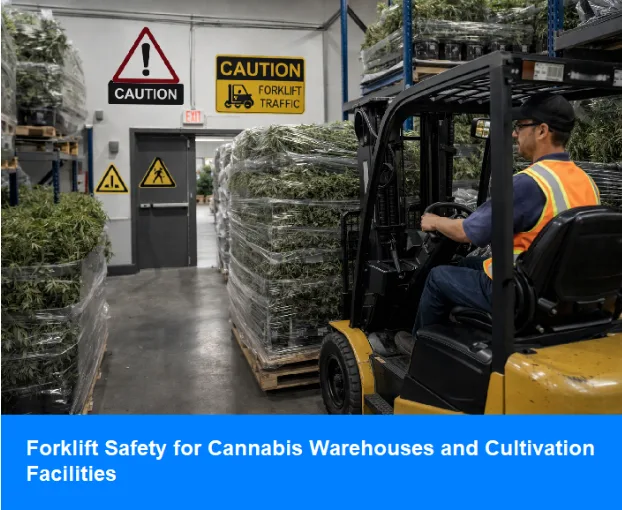
Warehouse operations create heavy exposure to lifting, pushing, pulling, stacking, and walking-surface hazards.
Common injury patterns:
back and shoulder strains
slips and falls
injuries from poor pallet handling
cart and stocking injuries
Dispensary operations
Retail may look lower-risk than cultivation or manufacturing, but dispensaries still generate workers’ compensation claims. Employees stand for long periods, restock product, bend into safes or storage areas, and move quickly in customer-facing spaces.
Common injury patterns:
strains from restocking
slips during cleaning or in entry areas
repetitive stress from standing and reaching
cuts from opening boxes or handling display materials
Why these injuries keep happening
Cannabis injuries often persist for the same reason losses persist in other emerging industries: the business is focused on growth, production, compliance, and speed, while basic operational discipline matures more slowly.
Some of the most common drivers include:
Weak supervisor training
A written policy does not prevent injuries by itself. Frontline supervisors shape daily behavior. If supervisors do not know how to spot risky lifting, bad posture, workstation problems, housekeeping failures, or early signs of strain, injuries will continue.
Poor ergonomics
Many cannabis operations grow fast and adapt spaces as they go. That often means workstations were never designed intentionally for the task. Employees then absorb the inefficiency physically.
Inconsistent SOPs
If safe lifting, machine clearing, tool use, housekeeping, and reporting expectations are not standardized, employees fill in the gaps with habit and speed.
Poor housekeeping
Cannabis facilities can generate debris, moisture, packaging waste, cords, hoses, and clutter. Once housekeeping slips, injury potential rises quickly.
Rushed production
When throughput becomes the only priority, employees cut corners, skip safe lifting, ignore discomfort, and work through bad conditions until something gives.
Delayed reporting
One of the biggest mistakes management makes is allowing employees to “wait and see” after a strain or repetitive-use complaint. Delayed reporting often makes claims worse, treatment more complicated, and return-to-work harder.
Realistic claim scenarios
Claim scenario 1: Trim room repetitive stress claim
A trimmer spends weeks working ten-hour shifts during peak production. The trim station is too low, the chair offers poor support, and output expectations discourage micro-breaks. The employee begins experiencing wrist pain and numbness but says nothing until the pain interferes with sleep. The eventual claim involves medical treatment, physical therapy, time away from work, and difficulty returning to the same function.
What went wrong:
poor workstation design
insufficient task rotation
weak supervisor awareness
delayed reporting
What could have reduced the loss:
ergonomic evaluation of trim stations
planned micro-breaks
cross-training and rotation
supervisor check-ins for early symptom reporting
Claim scenario 2: Warehouse lifting injury
A warehouse employee lifts a case of packaged product from an awkward lower shelf while turning to place it on a cart. He feels immediate lower back pain. The operation has no consistent lifting guidelines, no mechanical assist tools in that area, and no refresher training on material handling. The claim becomes a lost-time file and the business scrambles to cover the employee’s role.
What went wrong:
poor storage design
weak lifting practices
no engineered assist
no meaningful refresher training
What could have reduced the loss:
better shelf-height planning
two-person lift protocols where appropriate
carts or lift-assist tools
regular lifting practice coaching
Claim scenario 3: Slip in cultivation corridor
An employee carrying supplies through a cultivation corridor slips on residual water from irrigation activity. The floor had no immediate hazard marking, and the housekeeping response was informal rather than assigned and verified. The employee suffers a knee injury and misses work.
What went wrong:
weak floor monitoring
poor hazard communication
lack of ownership for cleanup
What could have reduced the loss:
defined housekeeping accountability
immediate spill response procedures
floor inspections during active operations
better footwear expectations
Prevention strategies management can actually implement
The most effective cannabis safety programs are not built on slogans. They are built on process discipline.
Train supervisors to identify injury drivers early
Supervisors should know how to spot:
poor lifting mechanics
awkward posture
unsafe pacing
workstation mismatch
recurring housekeeping breakdowns
early complaints of soreness, numbness, or fatigue
If supervisors are only trained to enforce production, they will miss the indicators that drive claims.
Improve workstation design
Review trimming, packaging, and bench workstations for:
table height
seat support
reach distance
lighting
foot support
anti-fatigue protection for standing work
tool placement
Small ergonomic improvements can materially reduce repetitive stress complaints.
Standardize SOPs for high-frequency tasks
Focus especially on:
lifting and material handling
spill response
machine clearing
blade and cutting tool use
restocking
housekeeping checks
early injury reporting
Good SOPs should be practical, short enough to follow, and reinforced through observation.
Build housekeeping into operations, not afterthoughts
Do not treat housekeeping as something done “when there is time.” In cannabis, it should be an assigned operational function with accountability. Walkways, trim rooms, stock areas, break areas, and production zones should have clear ownership and inspection routines.
Use task rotation where feasible
Task rotation can help reduce repetitive strain exposure, especially in trimming and packaging environments. It is not a cure-all, but when used thoughtfully, it can reduce the concentration of repetitive stress on the same body parts.
Reinforce proper lifting and material handling
This should go beyond a one-time orientation talk. Good programs address:
load size limits
storage design
use of carts and assist devices
two-person lift rules
body positioning
pace expectations
Require prompt reporting and respond well when it happens
Employees are more likely to report discomfort early when they believe management will respond constructively. That matters. Early reporting often means earlier intervention, better medical outcomes, lower claim severity, and smoother return-to-work planning.
Match PPE to the task
PPE will not solve every injury problem, but it still matters. Gloves, cut-resistant options where appropriate, slip-resistant footwear expectations, eye protection, and task-specific equipment should be reviewed by exposure, not purchased generically.
Review near misses and minor incidents
A near miss is often a preview of a future claim. If product keeps ending up on the floor in the same area, if employees regularly complain about wrist pain in one department, or if a packaging station causes repeated discomfort, management should treat that as claims intelligence.
Create modified duty plans before injuries happen
One of the best ways to control claims outcomes is to have transitional duty options ready. Without a plan, even modest injuries can turn into longer absences and higher claim costs.
Common mistakes cannabis businesses make that increase injury risk
The following mistakes show up repeatedly:
assuming injuries are just part of the business
treating trimming and packaging pain as normal instead of preventable
promoting supervisors without safety leadership training
relying on generic safety manuals that do not reflect cannabis workflows
failing to redesign bad workstations
allowing clutter, debris, or moisture to become normalized
delaying claim reporting
failing to investigate the root cause of “minor” injuries
pushing production without equal attention to process discipline
viewing workers’ compensation as an insurance issue only, rather than an operational issue
That last mistake is especially expensive. By the time a claim reaches the insurance carrier, the operational failure has already happened.
Injury prevention is a cost-control and insurability strategy
Well-run cannabis operators eventually realize that injury prevention does more than reduce pain and disruption. It can improve the business’s overall risk profile.
Fewer injuries and better-managed claims can help:
reduce claim frequency
reduce the chance of severe claims
improve workforce stability
support stronger renewal discussions
protect experience modification performance
strengthen the company’s story with underwriters
lower long-term workers’ compensation costs
In a challenging insurance environment, that matters. Underwriters pay attention to patterns. A cannabis business that can demonstrate real safety discipline, supervisor engagement, reporting consistency, and loss prevention effort is in a stronger position than one that simply says it takes safety seriously.
Conclusion
The most common workplace injuries in cannabis are not mysterious. They usually come from repetitive work, poor ergonomics, rushed lifting, weak housekeeping, inadequate supervision, and inconsistent execution of basic safety disciplines.
That is the good news as well as the warning.
These injuries are often preventable. Operators that take workstation design seriously, train supervisors well, enforce housekeeping, improve material handling, require early reporting, and build safety into daily management can reduce claims, improve outcomes, and put themselves in a better position operationally and financially.
In cannabis, injury prevention is not separate from business performance. It is part of it.
A note on HISIG and customized loss prevention
For California cannabis operators, this is one reason programs like HISIG can be so valuable. HISIG is designed for stronger operators that want more than a basic workers’ compensation policy. In addition to the potential long-term economic advantages of a well-run self-insured structure, members benefit from customized loss prevention support tailored to their actual operations, workflows, and injury trends. That kind of hands-on guidance can help companies address the root causes behind repetitive injuries, lifting claims, housekeeping failures, and weak reporting practices before they become expensive patterns. For operators that want a more strategic approach to workers’ compensation and injury prevention, it is worth taking a closer look at whether HISIG is the right fit.
The most common injuries include repetitive motion injuries, strains and sprains, lifting injuries, slips and falls, cuts and lacerations, machine-related injuries, and ergonomic injuries tied to poor workstation design.
Cultivation, trimming, post-harvest processing, manufacturing, packaging, warehouse, distribution, and dispensary operations all create exposure, but the injury pattern differs by function. Trim rooms tend to generate repetitive stress claims, while warehouse and cultivation operations often generate lifting and slip claims.
Claims become expensive when injuries are reported late, supervisors are poorly trained, modified duty is not available, ergonomics are ignored, or management fails to address the root operational issue that caused the injury.
Yes. Better workstation height, seating, tool placement, anti-fatigue support, task rotation, and workflow design can reduce repetitive stress and strain exposures, especially in trimming, packaging, and bench-based production tasks.
Better injury prevention can reduce claim frequency, improve claims outcomes, protect experience modification performance, strengthen renewal discussions, and improve how underwriters view the business over time.