Some workplace incidents create inconvenience. Forklift incidents can shut down part of an operation.
They can seriously injure employees, damage buildings, destroy high-value product, interrupt post-harvest flow, create liability issues with pedestrians or visitors, and trigger workers’ compensation, property, and third-party claims at the same time. In a cannabis facility, where inventory may be highly valuable, aisles may be tight, workflows may be compressed, and production schedules may already be under pressure, a single forklift event can become much more costly than management expected.
That is why forklift safety deserves far more attention than it often gets.
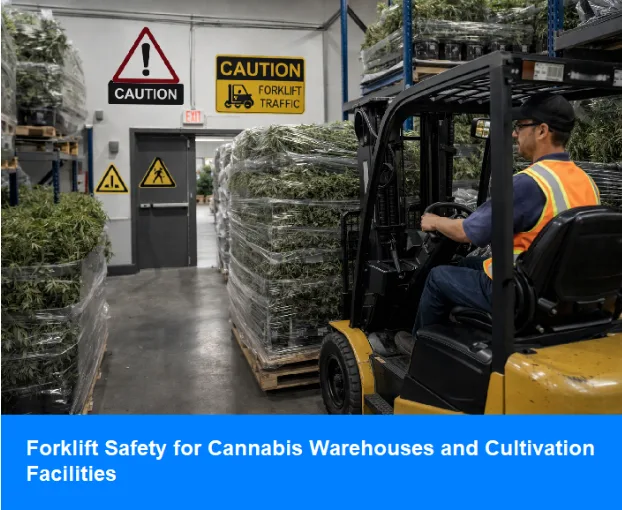
In cannabis operations, forklifts and similar powered industrial trucks may be used in warehouses, packaging areas, post-harvest storage, cultivation support operations, distribution zones, and mixed-use production spaces where product, people, carts, pallets, and equipment all compete for room. These environments create real loss exposure, especially when traffic flow is poorly controlled, inspection discipline is inconsistent, surfaces are wet or uneven, temporary storage clogs the layout, or operators are rushed.
Forklift incidents are often severe, disruptive, and preventable. The best cannabis operators understand that forklift safety is not just a training issue. It is a traffic-management issue, a supervision issue, a maintenance issue, and an operational-discipline issue.
Why Forklift Safety Matters So Much in Cannabis Operations
Forklift losses tend to be different from many ordinary workplace injuries because the stakes escalate quickly.
A repetitive strain complaint may build slowly. A housekeeping issue may lead to a slip claim with varying severity. A forklift event, by contrast, can cause immediate and serious consequences. An employee can be pinned, struck, or knocked down. Product can be crushed or contaminated. Racking can be damaged. A wall, cooler, roll-up door, irrigation component, electrical system, or packaging line can be hit. In facilities with mixed pedestrian traffic, a single visibility failure or turning error can injure someone who was never supposed to be in the equipment path in the first place.
Cannabis facilities often add another layer of exposure because they are not always designed from the beginning as ideal forklift environments. Operators may work in converted industrial buildings, retrofitted grow spaces, older warehouses, or mixed-use facilities where aisles, storage practices, floor conditions, and line-of-travel controls are less than perfect. During busy harvest, packaging, or shipment periods, temporary staging can make that worse.
From a risk management perspective, forklift safety affects more than workers’ compensation. It can affect property loss, product spoilage, inventory shrinkage, liability exposure, OSHA issues, downtime, and operating continuity.
The Most Common Forklift Accident Drivers in Cannabis Facilities
Most forklift claims do not happen because forklifts are inherently unpredictable. They happen because the environment, the operator, the equipment, or the process was not controlled well enough.
Poor Traffic Flow
One of the biggest drivers is weak traffic design. When forklifts and pedestrians share the same travel paths without clear separation, marked crossings, visual controls, or disciplined right-of-way practices, the likelihood of a serious event rises quickly.
This is especially dangerous in facilities where employees move between packaging, storage, cultivation support, trimming, and loading zones throughout the day.
Inadequate Operator Training
Training failures remain a major loss driver. Some businesses assume that because an employee has forklift experience elsewhere, they are ready to operate in the current facility. That is not enough.
A cannabis operation may have narrow aisles, unusual product storage practices, wet zones, visibility challenges, and mixed traffic patterns that require site-specific instruction and evaluation. If training is weak, rushed, undocumented, or not reinforced, the risk remains elevated.
Weak Inspection Discipline
Forklift safety starts before the first load is moved. If pre-shift inspections are inconsistent, operators may use equipment with tire issues, brake issues, steering problems, mast concerns, leaks, or other mechanical deficiencies that should have removed the unit from service.
A weak inspection culture often signals a broader discipline problem.
Unsafe Pedestrian Interaction
Many severe forklift incidents involve a pedestrian. Sometimes the pedestrian walks behind the unit. Sometimes they step into an aisle without checking. Sometimes they assume the operator sees them. Sometimes the operator is reversing with limited visibility and no effective spotter or control system in place.
In cannabis facilities, where employees may move between departments quickly and workspaces can feel crowded, unsafe pedestrian interaction is one of the clearest areas for improvement.
Speed, Time Pressure, and Shortcuts
Busy facilities create temptation. A driver cuts a turn too tightly. A load is moved with limited visibility. A pallet is carried higher than it should be. A corner is taken too fast. A horn is not used. A pedestrian lane is crossed casually. A damaged pallet is moved anyway.
These are not random errors. They are predictable behaviors in operations where speed quietly outranks discipline.
Cannabis-Specific Conditions That Increase Forklift Exposure
Cannabis operations have several characteristics that can make forklift risk worse if management is not intentional.
Congestion is a major issue. Temporary storage, work-in-process staging, packaging materials, harvest bins, racks, carts, and pallets can narrow travel lanes and reduce turning room.
Wet areas also matter. Cultivation support areas, irrigation zones, wash-down sections, and transitional spaces between grow and storage functions may create slippery surfaces or degraded floor conditions.
Narrow aisles are common in facilities trying to maximize usable space. That increases strike risk, especially if operators are moving quickly or carrying loads that limit sightlines.
Temporary storage practices can also create instability. When product, pallets, or supplies are staged “just for now,” traffic paths often become less predictable. In practice, temporary usually lasts longer than intended.
Mixed pedestrian and equipment traffic is another major challenge. In many cannabis facilities, forklift activity takes place near employees who are not warehouse specialists. Trimmers, packaging staff, cultivation personnel, maintenance workers, and supervisors may all move through overlapping areas.
That is why generic forklift advice is not enough. Cannabis businesses need site-specific controls based on how their operations actually function.
Realistic Claim Scenarios
Warehouse Pedestrian Strike Scenario
A forklift operator in a cannabis warehouse is moving packaged product toward a staging area during a busy outbound period. Temporary pallets have narrowed the aisle, and a packaging employee steps around a corner into the travel path while carrying materials. The operator is reversing with partial visibility and reacts too late. The employee is knocked down and suffers a serious leg injury.
This is not just a training problem. It is a traffic-control, storage-discipline, and pedestrian-separation failure.
Cultivation Support Property Damage Scenario
In a cultivation support area, an operator transporting irrigation supplies turns too tightly on a wet section of floor near a transitional grow access point. The forklift skids slightly and strikes a wall and nearby environmental control equipment. No one is hurt, but repairs are expensive and part of the operation is disrupted.
This kind of loss shows how forklift risk can affect property, production, and business continuity, not just bodily injury.
Post-Harvest Storage Product Loss Scenario
During post-harvest movement, a forklift operator lifts a pallet of packaged flower that was stacked poorly and wrapped inadequately. The load shifts while turning in a tight aisle, and product falls, causing damage and contamination concerns. Management now faces not only equipment concerns but also product loss and delay.
This is a load-security and handling-discipline problem, not bad luck.
Loading Area Injury Scenario
A forklift operator in a distribution zone attempts to speed up trailer loading near the end of the day. The operator skips a full pre-shift check, does not sound the horn approaching a blind intersection, and clips a pallet that forces nearby material into a worker’s path. The worker twists to avoid impact and suffers a back injury.
This is how shortcuts turn into workers’ compensation claims even when the forklift itself does not directly strike the person.
What Practical Forklift Controls Actually Work
The best forklift safety programs are operational. They show up in layout, training, inspection, traffic control, supervision, and enforcement.
Site-Specific Operator Training
Operators should be trained not just on forklift basics, but on the actual layout, hazards, floor conditions, traffic interaction, load handling practices, and visibility issues in the specific cannabis facility where they work.
Training should include evaluation, not assumption. Prior experience is not a substitute for current qualification.
Pre-Shift Inspection Discipline
A forklift should be inspected at the start of each shift. Tire condition, brakes, steering, mast function, forks, warning devices, leaks, and overall mechanical condition all matter. Defective units should be removed from service promptly.
Inspection is one of the simplest ways to reduce preventable equipment-related incidents.
Traffic Management and Pedestrian Separation
Marked lanes, defined crossings, mirrors at blind intersections, stop points, speed expectations, horn-use rules, controlled staging, and clear separation between pedestrians and equipment are all practical controls that materially reduce risk.
In many cannabis facilities, traffic design is the missing piece.
Better Housekeeping and Storage Discipline
Forklifts perform badly in clutter. Temporary storage should not take over travel paths. Pallets should be stacked correctly. Aisles should stay open. Waste, debris, and stray materials should not be allowed to turn routine travel into a daily obstacle course.
Surface Management
Uneven, wet, or damaged floors increase risk, especially where cultivation support and warehouse functions overlap. If management knows certain zones regularly become slick or uneven, those conditions should be corrected, controlled, or routed around rather than tolerated.
Load Handling Rules
Loads should be stable, properly wrapped or secured, and carried in a way that preserves visibility and control. Employees should not improvise with unstable pallets, overloaded forks, or awkwardly staged product because “it will only take a second.”
Maintenance and Repair Discipline
Forklift maintenance is not optional. Mechanical issues should be documented, addressed promptly, and repaired by qualified personnel. Operators should not be expected to work around known defects.
Why Enforcement and Supervision Matter
Many forklift programs look adequate on paper. That does not mean they are working.
The difference usually comes down to supervision and enforcement.
If supervisors tolerate speeding, blocked aisles, informal pedestrian crossings, poor staging, or skipped inspections, the written program means very little. If managers only pay attention after a near-miss or accident, the operation is already behind.
Forklift safety improves when front-line leaders actively watch traffic conditions, correct unsafe behavior, enforce staging rules, and make it clear that throughput does not excuse shortcuts.
That is one of the biggest lessons in cannabis risk management: the real safety program is the one that is enforced.
HISIG and GotSafety
For cannabis businesses that want more structure around forklift safety, it is worth noting that HISIG provides forklift training to its members at no added cost, and GotSafety offers online safety training resources that can reinforce day-to-day operator education and documentation. GotSafety’s published materials say HISIG members receive free access to the client center, mobile app, and extensive online training resources, and that GotSafety’s offerings include forklift operation training, inspections, documentation support, hazard correction guidance, and on-site bilingual training options in California. The platform also includes large video libraries in English and Spanish, employee training tracking, and administrative tools to help businesses monitor compliance and safety activity. (Cannabis Risk Manager)
Common Weaknesses That Keep Forklift Claims Elevated
Cannabis businesses often struggle with the same forklift-related weaknesses.
One is treating forklift safety as an annual training event instead of a daily operational discipline.
Another is allowing mixed pedestrian and equipment traffic without meaningful separation or control.
Another is tolerating temporary storage in travel lanes because production pressure makes it feel unavoidable.
Weak pre-shift inspection habits are another common issue. So is poor follow-through on maintenance.
And finally, some operators underestimate how quickly a forklift issue can become a multi-line loss involving workers’ compensation, building damage, product damage, liability concerns, and downtime all at once.
How Stronger Forklift Safety Improves Insurance and Operational Results Over Time
Forklift safety affects more than one claim.
When severe incidents are reduced, a business often sees fewer serious injury losses, fewer disruption events, cleaner property experience, less product damage, and better operating continuity. Over time, that can improve loss runs, support a stronger underwriting story, and reduce the hidden operational drag that comes from preventable equipment incidents.
This matters in cannabis because many facilities already operate with margin pressure, regulatory pressure, and labor pressure. A severe forklift loss does not just show up in one reserve. It can ripple through staffing, production, compliance, customer service, and capital planning.
That is why stronger forklift safety should be viewed as a business discipline, not just a warehouse task.
Final Takeaway
Forklift incidents in cannabis facilities are often severe, disruptive, and preventable.
Poor traffic flow, weak operator training, inconsistent inspections, unsafe pedestrian interaction, congestion, wet or uneven surfaces, narrow aisles, and temporary storage practices all increase the chance of a serious loss. The businesses that perform better are the ones that manage those conditions intentionally.
Better training, better inspection discipline, better maintenance, stronger traffic control, cleaner storage practices, and real enforcement can materially reduce injuries, property damage, product loss, liability exposure, and downtime.
In cannabis warehouses and cultivation support environments, forklift safety is not a side issue. It is part of protecting people, product, property, and the continuity of the operation itself.