Many cannabis businesses still approach workers’ compensation the wrong way. They shop the renewal, focus on the rate, and hope a different carrier or broker will somehow solve the problem. That may create temporary relief, but it rarely changes the underlying economics of the account.
Workers’ compensation cost control is not just about buying a cheaper policy. In cannabis, the operators that reduce cost over time usually do four things better than everyone else: they prevent injuries, report claims quickly, manage post-injury process tightly, and treat claims handling as an operational discipline rather than an insurance afterthought.
That matters because workers’ compensation is one of the few major insurance costs a cannabis operator can materially influence through day-to-day management. When injuries rise, claims drag on, or supervisors fail to intervene early, the business does not just pay for it in premium. It pays through downtime, overtime, temp labor, lower morale, production disruption, weaker renewal leverage, and a reputation as a harder risk to insure.
For cannabis companies trying to improve margins, strengthen insurability, and run cleaner operations, workers’ compensation should be treated as a floor-level management issue, not just a finance issue.
Why shopping price alone usually fails
A cheaper premium can feel like progress, but it often masks a larger problem. If the operation is generating repetitive strain injuries, lifting claims, slip-and-fall losses, or delayed reporting, the cost pressure usually comes back.
The best operators understand that workers’ compensation cost is shaped by more than the quoted rate. It is influenced by:
Claim frequency
Claim severity
Payroll and job classifications
Experience modification or loss history
Reserve development
Return-to-work performance
Supervisory consistency
Medical and claims management quality
In other words, workers’ compensation is not just an insurance purchase. It is the financial output of how the operation is actually being run.
A cannabis company that keeps employees safe, documents training, responds quickly to incidents, and actively manages claims will often outperform a competitor with similar payroll and headcount. Over time, that difference shows up in lower total cost of risk, better underwriting results, and more carrier interest.
The injury patterns that commonly drive workers’ compensation costs in cannabis
Cannabis operations have their own injury patterns. Some are obvious. Others become expensive because management normalizes them until they produce chronic claims or bad habits.
Common drivers include:
Repetitive motion and ergonomic strain
Trimmers, packagers, pre-roll teams, and manufacturing employees often perform repetitive hand, wrist, shoulder, and neck movements for long periods. Poor workstation design, production pressure, and inadequate rotation can turn small discomfort into recordable injuries and lost-time claims.
Lifting and material handling
Cultivation, warehouse, and distribution teams regularly move soil, nutrients, packaged product, boxes, and other materials. Back strains, shoulder injuries, and sprains are common when lifting expectations outpace training, equipment, or staffing.
Slips, trips, and falls
Wet floors, irrigation overspray, trimming debris, warehouse congestion, and rushed workflows create steady slip-and-fall exposure. These claims are often dismissed as minor until one becomes a surgery file.
Cuts and lacerations
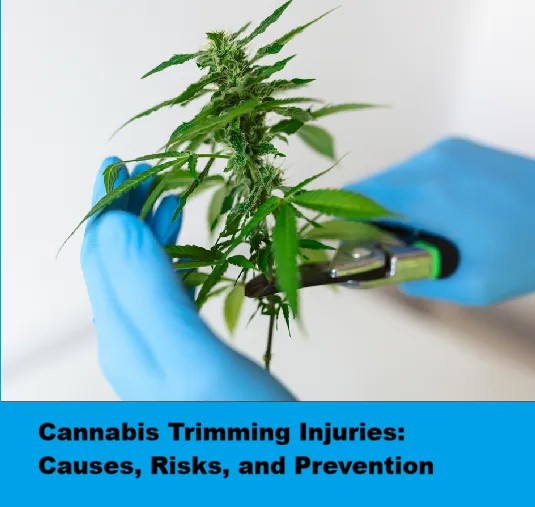
Manufacturing and trimming operations may involve blades, shears, tools, or repetitive processing equipment. Weak guarding, inconsistent PPE use, or rushed handling can lead to hand injuries.
Production pace and fatigue
Cannabis businesses under labor pressure often push teams to move faster without adjusting staffing, ergonomics, rest breaks, or supervisory oversight. That is when form deteriorates, shortcuts appear, and injury frequency climbs.
Weak frontline supervision
A surprising number of workers’ compensation problems start with inconsistent supervisors. When managers do not enforce lifting practices, fail to respond to early discomfort complaints, or treat reporting as a nuisance, claims tend to become more frequent and more expensive.
How injuries affect premium, experience mods, and total cost of risk
One preventable injury can cost more than the direct claim payment.
When claims increase, cannabis businesses can face:
Higher experience mods or deteriorating loss experience
Less favorable underwriting at renewal
Higher collateral or tighter program terms in some structures
More conservative reserving by carriers or TPAs
Increased indirect labor cost from overtime or replacement staff
Production inefficiency and supervisory distraction
This is where many operators underestimate the problem. They focus on premium and ignore the hidden cost stack behind the claim.
A shoulder strain in cultivation may lead to medical treatment, modified duty, and wage replacement. But it may also create missed work, extra burden on the crew, delayed output, management time, employee dissatisfaction, and a larger reserve than the final claim value would suggest. Enough files like that can materially affect an account’s trajectory.
In cannabis, especially in labor-intensive operations, claim frequency often matters as much as the occasional large loss. Underwriters notice patterns. Five avoidable ergonomic or lifting claims tell a story about process and supervision.
Realistic cannabis claim scenarios
Cultivation: repetitive strain becomes a lost-time claim
A cultivation employee spends long shifts bucking, trimming, and hanging product during a heavy harvest cycle. The workstation is not adjusted well, task rotation is inconsistent, and the employee has been mentioning wrist pain for two weeks. No supervisor escalates it. The pain worsens, the employee seeks treatment, and the file develops into a repetitive trauma claim with lost time.
What went wrong: no early intervention, weak ergonomic review, poor task rotation, and a supervisor who treated discomfort as routine.
What could have reduced cost: early reporting, workstation redesign, scheduled rotation, stretch protocols, and prompt modified duty.
Manufacturing: lifting injury in packaging or extraction support
An employee in manufacturing lifts a box of finished product or supplies awkwardly from a low pallet while trying to keep pace with production. The employee feels a sharp back strain and reports it the next day after symptoms worsen.
What went wrong: poor material handling setup, avoidable manual lift, and likely production pressure.
What could have reduced cost: lift assists, better pallet height, team-lift rules, training reinforcement, and immediate same-day reporting.
Warehouse or distribution: slip-and-fall near receiving
A warehouse employee walks through a receiving area where water and debris have collected near an entry point. Housekeeping is inconsistent and the walkway is partially obstructed. The employee slips, injures a knee, and later requires extended treatment.
What went wrong: poor housekeeping, weak inspection discipline, and lack of ownership for floor conditions.
What could have reduced cost: floor inspection routines, clear accountability, anti-slip controls, and hazard correction before the incident.
Dispensary: stockroom strain with no return-to-work plan
A dispensary employee strains a shoulder while moving product totes in the back-of-house area. The company has no meaningful modified-duty plan, so the worker remains out longer than necessary. The claim becomes more expensive than the injury itself would normally justify.
What went wrong: the injury may have been manageable, but weak post-injury process increased claim cost.
What could have reduced cost: better stockroom ergonomics, clear lifting limits, and a structured return-to-work program.
What cannabis operators can actually do to lower workers’ compensation costs
The strongest workers’ compensation strategies are usually not flashy. They are operational, repeatable, and enforced.
Identify the injury trends by department, not just companywide
Do not treat workers’ compensation as one number. Break losses down by function:
Cultivation
Harvest and post-harvest
Trimming
Manufacturing and packaging
Warehouse and distribution
Retail and dispensary
Delivery, if applicable
You want to know where claims are coming from, what body parts are involved, what tasks were being performed, and which supervisors or shifts are overrepresented. That is where cost control starts.
Fix ergonomics in the places where cannabis work is repetitive
Ergonomics is not just for office environments. In cannabis, it is often one of the biggest missed opportunities.
Practical improvements may include:
Adjustable tables and work surfaces
Better seating or anti-fatigue support where appropriate
Task rotation for repetitive functions
Smarter layout to reduce reach, twist, and carry motions
Scheduled micro-breaks during repetitive processing work
Review of hand tools, shears, and packaging equipment
Lift tables, carts, and material handling aids
If trimming, packaging, or repetitive production is part of the operation, ergonomics should be reviewed as seriously as security or compliance.
Train supervisors to manage injury risk, not just production
Many companies train employees but undertrain supervisors. That is a mistake.
Frontline managers should know how to:
Spot unsafe lifting and repetitive strain patterns
Address housekeeping failures immediately
Escalate discomfort complaints before they become claims
Document incidents properly
Trigger prompt reporting and medical direction
Reinforce modified-duty expectations
A weak supervisor can quietly undo an otherwise good safety program.
Improve injury reporting speed
Delayed reporting drives cost higher. It creates room for factual confusion, delayed treatment direction, avoidable attorney involvement, and reserve inflation.
Cannabis operators should build a culture where employees report injuries immediately and supervisors understand that prompt reporting is mandatory, not optional. The goal is not to discourage reporting. The goal is to surface issues early, respond consistently, and prevent small claims from becoming worse files.
Build a real return-to-work program
A strong return-to-work program is one of the most effective workers’ compensation cost controls available, and many cannabis businesses still do not use it well.
Modified-duty options might include:
Inventory reconciliation
labeling or light packaging tasks
administrative support
training support
compliance documentation
light inspection work
non-strenuous stock organization
When a worker can return safely in a meaningful, restricted role, indemnity exposure often improves and claims tend to stabilize faster. It also helps maintain engagement with the workplace and reduces the drift that can make claims more difficult.
Tighten housekeeping and floor-conditiondiscipline
This sounds basic because it is basic. It is also one of the easiest ways to reduce preventable claims.
In cultivation, warehouse, and manufacturing settings, disciplined floor management matters. Water, plant matter, packaging debris, cords, and clutter create avoidable injuries. The key is not writing a housekeeping policy. The key is assigning ownership and enforcing it every shift.
Rework lifting and material handling expectations
If employees are still manually lifting loads that could be staged differently, moved with equipment, or broken into smaller units, management is accepting unnecessary strain exposure.
Review:
pallet heights
storage layout
tote and box weights
use of carts or lift assists
awkward carries
team-lift rules
receiving and staging flow
A lot of “random” strain claims are not random at all. They are process problems.
Make safety meetings useful
Too many safety meetings are forgettable. The best ones are brief, specific, and tied to actual exposures the workforce sees every day.
Good cannabis safety meetings should address topics like:
repetitive task fatigue during heavy production periods
proper use of carts and material handling aids
slip hazards in cultivation or warehouse zones
safe use of cutting tools
reporting discomfort early
incident lessons learned from actual near-misses
When safety communication is credible and practical, employees are more likely to engage.
Why claims handling and vendor support matter
Two companies can have similar injuries and very different claim outcomes.
That difference often comes down to claim handling discipline and vendor quality. Workers’ compensation cost control is heavily influenced by what happens after the injury.
Areas that matter include:
quality of the adjuster
speed of initial contact
medical network direction
nurse triage or clinical coordination where appropriate
communication with supervisors and HR
reserve philosophy
return-to-work coordination
defense management on litigated files
broker or consultant involvement on problem claims
A cannabis operator should not assume every claim will manage itself once reported. Files should be reviewed. Trends should be monitored. Problem claims should be escalated early.
This is especially important for accounts trying to improve loss performance and position themselves for better program options down the road.
Common mistakes that keep workers’ compensation costs high
Treating workers’ compensation as only an insurance issue
When finance owns the renewal but operations ignores injury drivers, cost usually stays elevated.
Delayed reporting
Late notice creates friction, confusion, and worse outcomes.
No modified-duty process
Without return-to-work structure, manageable claims become more expensive.
Poor supervisor accountability
Policies do not matter much if frontline leaders do not enforce them.
Generic training
Employees need training tied to actual cannabis workflows, not recycled safety language.
Ignoring minor discomfort trends
A business that waits for “real claims” misses the early warning signs.
Weak post-claim oversight
If no one is reviewing open claims, reserves, and return-to-work status, the company is letting cost drift upward.
Focusing only on premium
This is probably the most common mistake of all. A cheap renewal cannot offset a weak operation forever.
Insurance and program structure implications
Workers’ compensation pricing and program flexibility improve when an operator demonstrates discipline. Better-run cannabis businesses tend to get more credibility with underwriters because they can show the story behind the numbers.
That means:
cleaner claim trends
better reporting practices
stronger training documentation
management engagement in loss control
willingness to review open claims and return-to-work
a culture that treats injuries as preventable and manageable
For larger or more sophisticated operators, workers’ compensation performance can also affect access to stronger long-term program structures, loss-sensitive options, or more favorable underwriting treatment. Not every cannabis business is ready for those structures, but poor injury control almost always narrows the field.
The point is simple: workers’ compensation cost control is operational first and transactional second.For some operators, better workers’ compensation results can also open the door to more strategic program options.
For operators with stronger loss control, better structures may become available
For some cannabis businesses, improving workers’ compensation performance does more than reduce claims and stabilize premium. It can also create access to stronger long-term program structures. One example is HISIG, a California workers’ compensation self-insured group built for safety-driven cannabis employers. The model is designed for operators that take injury prevention, claim oversight, and management accountability seriously — not those simply looking for a cheaper quote. For qualified businesses, programs like this may offer a more strategic path to cost control, stronger claims support, and long-term financial advantage. For operators that believe they may be ready, it is worth evaluating whether their current workers’ compensation structure still fits the quality of their operation.
Final takeaway
Cannabis businesses do not lower workers’ compensation costs in a durable way by chasing the cheapest quote each year. They do it by running safer operations, tightening reporting, managing claims actively, and building enough discipline into the business that injuries become less frequent and less severe.
That is what separates strong operators from frustrated ones.
The best cannabis companies understand that workers’ compensation is not just a line item. It is a visible measure of management quality. When safety, supervision, ergonomics, return-to-work, and claim oversight improve, cost usually follows.
And when cost improves for the right reasons, insurability tends to improve with it.