Most cannabis operators know a workplace injury can lead to a workers’ compensation claim.
Far fewer understand how often the claim payment is only the beginning.
The real cost of an injury can spread across overtime, production delays, supervisor distraction, replacement labor, retraining, morale issues, claims friction, quality problems, and higher long-term insurance cost.
A back strain in cultivation, a repetitive wrist injury in trimming, a slip in a processing room, or a warehouse lifting loss may look manageable at first. But once the ripple effects move through the operation, the total cost can be far greater than the initial medical bill or indemnity payment.
That is one of the most important risk management lessons in cannabis.
Workplace injuries are not just insurance events. They are operational and financial events.
For cannabis owners, CFOs, COOs, HR leaders, cultivation leaders, manufacturing leaders, warehouse managers, safety managers, and risk managers, injury prevention should be viewed as a financial strategy, not just a compliance exercise.
What the “True Cost” of a Workplace Injury Really Means
When people talk about the cost of a workplace injury, they often focus on the obvious line item: the claim.
That usually means medical treatment, wage replacement, and related claim expense. Those direct costs matter, but they rarely tell the whole story.
The true cost of an injury includes everything the business absorbs because the injury happened. That may include:
slower output
overtime for coworkers
temporary labor
manager time
training for replacement staff
disrupted schedules
production inefficiency
customer service issues
loss of momentum in already complex workflows
In cannabis, where labor, compliance, and process timing already require close coordination, those indirect costs can be significant.
In practical terms, a claim may be one invoice stream. The true cost is the wider business disruption.
Direct vs. Indirect Cost of Injuries
Direct Costs
Direct costs are the expenses most employers immediately recognize:
medical treatment
temporary disability or indemnity payments
claim handling expense
defense expense where applicable
reserve development
premium and pricing impact over time
These costs are real and measurable. They usually show up in the file, on loss runs, or later in renewal discussions.
Indirect Costs
Indirect costs are often harder to quantify, which is exactly why they are underestimated.
They can include:
lost productivity
overtime for other employees
temporary staffing or reassignment
supervisor and HR time
training and onboarding replacement workers
delays in cultivation, processing, packaging, shipping, or retail service
quality control problems caused by understaffing or inexperience
morale issues when teams absorb more work
turnover if employees feel the workplace is unsafe or unsupported
weaker operational continuity during peak periods
For many cannabis businesses, these indirect costs can be as important as the direct claim expense, and sometimes more damaging to the operation in the short term.
Why Workplace Injuries Are Especially Disruptive in Cannabis Operations
Cannabis businesses tend to be labor-intensive, process-sensitive, and timing-dependent.
Cultivation teams may be working through tightly scheduled watering, feeding, pruning, trellising, sanitation, and harvest cycles.
Trimming and processing teams often depend on repetitive manual labor, consistency, and throughput.
Manufacturing environments may rely on coordinated labor around packaging, batching, kitchen or extraction support, and assembly-line style workflows.
Warehouse and distribution teams must manage product movement, storage, staging, and delivery preparation.
Dispensary teams need staffing continuity, product handling discipline, and customer-facing reliability.
That means even a modest injury can quickly create friction.
A cultivation strain claim may affect harvest timing. A trimming-related wrist injury may reduce post-harvest output. A warehouse slip-and-fall can disrupt product staging and force overtime. A dispensary stocking injury can pull a trained employee off the floor and burden the rest of the team.
In cannabis, the injury often spreads operational consequences faster than management expects.
The Most Common Injury Cost Drivers in Cannabis Businesses
Many cannabis injuries look routine at first.
That is part of the problem.
Repetitive motion injuries in trimming, packaging, weighing, and labeling may begin as soreness before becoming meaningful claims.
Strains and sprains from moving pots, soil, trays, ingredients, or product often appear to be ordinary work injuries until restrictions, lost time, and productivity loss follow.
Slips and falls tied to wet floors, hoses, clutter, or poor housekeeping can create both immediate claim expense and wider disruption.
Cuts, machine-related incidents, and equipment interactions can result in medical costs, downtime, retraining, and procedure reviews.
The most common cost drivers often include:
repetitive hand-intensive work
awkward posture and poor ergonomics
lifting and manual material handling
wet conditions and housekeeping failures
weak supervision and delayed reporting
lack of modified duty or return-to-work planning
slow claims coordination
poor documentation and incident follow-up
When those conditions remain in place, injuries tend to become more frequent and more costly.
Realistic Cannabis Claim Scenarios
Cultivation
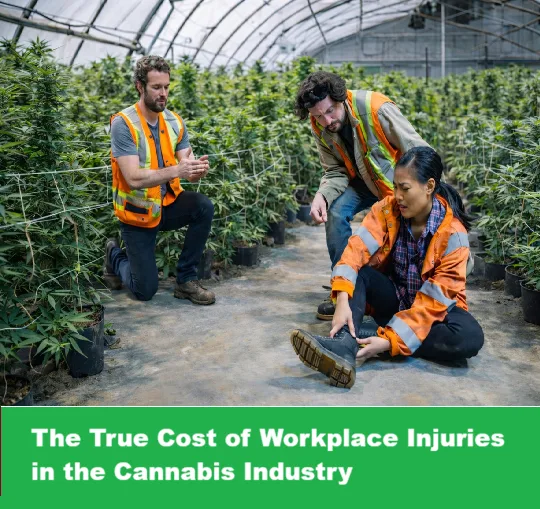
A cultivation employee strains their lower back moving saturated pots during a room reset.
The medical treatment is not catastrophic, but the employee cannot perform normal lifting duties for several weeks.
The business now has a claim, overtime pressure, disrupted workflow, and reduced productivity during a key cultivation cycle.
Trimming and Processing
A trimmer develops wrist pain, forearm tightness, and shoulder fatigue after repetitive hand work at a poorly designed station.
The issue is reported late because soreness has been normalized.
By the time restrictions are issued, output slows, the team is already short-staffed, and management must decide whether modified duty is available.
Manufacturing
A packaging employee on a repetitive production line develops neck and shoulder pain caused by poor reach distance, weak rotation, and pace pressure.
The direct claim cost may appear manageable at first, but the wider costs show up as slower line speed, replacement training, increased fatigue on the team, and more errors.
Warehouse and Distribution
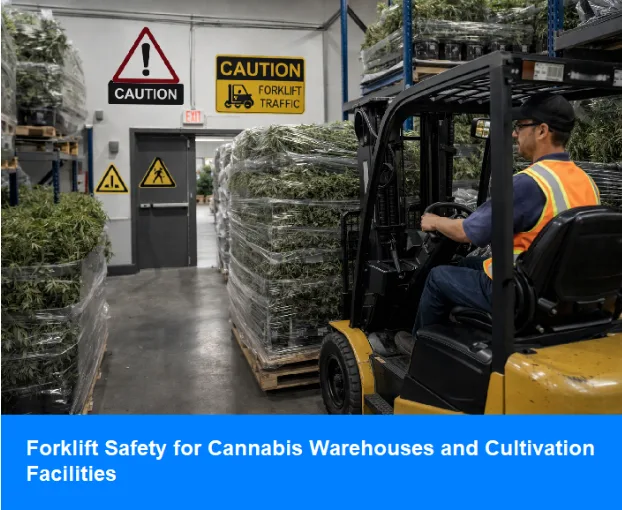
A warehouse employee slips near a staging area where housekeeping had been inconsistent.
The employee injures a knee and misses work.
The operation covers overtime, other staff rush to absorb the workload, and product movement slows.
One housekeeping failure creates multiple costs at once.
Dispensary
A dispensary employee strains a shoulder while lifting and stocking product from an awkward back-room setup.
The claim pulls a trained worker away from a customer-facing role, forcing schedule changes, retraining, and service disruption.
The injury affects both labor continuity and retail performance.
How Better Safety and Claims Practices Reduce Total Cost Over Time
The best cannabis operators do not just try to reduce injuries.
They try to reduce the total cost of injuries.
That starts with stronger safety systems:
real training
ergonomic review
clear SOPs
housekeeping discipline
inspection routines
supervisor engagement
earlier reporting
Many injuries become more expensive because the warning signs were there, but nobody acted quickly enough.
It also requires stronger claims management. Prompt reporting, clean documentation, coordinated medical direction where appropriate, active communication, and structured return-to-work planning can materially affect claim duration and severity.
The businesses that usually perform best are those that understand that safety and claims are connected.
A better safety program reduces claim frequency. Better reporting and better claim discipline reduce claim severity. Together, they improve long-term workers’ compensation performance.
How Injuries Affect Experience Mods, Long-Term Workers’ Comp Cost, and Total Cost of Risk
Injury cost does not end when the immediate disruption fades.
Over time, repeated claims and higher total incurred losses can affect:
experience modification, where applicable
workers’ compensation pricing
underwriting perception
the broader cost of risk
A business with recurring preventable injuries often tells a weaker story to the market than one with stronger safety discipline, quicker reporting, cleaner documentation, and better claims outcomes.
That matters in cannabis because many operators already face a challenging insurance environment. The more preventable loss activity a business carries, the less flexibility it usually has over time.
HISIG
For qualified California cannabis operators, a more disciplined workers’ compensation structure may also matter.
Cannabis Risk Manager’s May 2025 HISIG article describes the Household Industries Self-Insured Group as a self-insured group model built around vetted, safety-driven employers, active claims management, shared safety resources, and alignment between safety performance and long-term cost control.
The article says the model is designed to let members retain more of the financial benefit from better safety and more efficient claims handling than they typically would under a purely transactional guaranteed-cost structure.
For best-in-class operators, that can create stronger alignment between workplace discipline, claims outcomes, and total cost control over time.
GotSafety
Structured safety support can also reduce the true cost of injuries before and after a claim occurs.
Cannabis Risk Manager’s February 2026 GotSafety article says the platform offers free access for HISIG members to the client center, mobile app, and extensive online training resources, along with employee training tracking, documentation tools, company forms, bilingual resources, facility walk-throughs, hazard-correction guidance, and on-site bilingual safety training in California.
It also describes support for safety documentation, incident-related compliance materials, and inspection-driven hazard management.
In practical terms, that kind of infrastructure can help operators reduce injury frequency, improve defensibility, and enhance visibility into training and corrective actions across the workforce.
Common Mistakes Cannabis Businesses Make That Increase the True Cost of Injuries
One common mistake is focusing only on the claim payment and ignoring the operational disruption around it.
Another is reporting late. Delayed reporting often leads to worse medical management, worse documentation, and more friction in the file.
Another is failing to offer modified duty where appropriate. A manageable injury can become much more expensive when the employee has no structured return-to-work path.
Weak supervisor engagement is another recurring problem. If front-line leaders do not notice early symptoms, unsafe conditions, or recurring process issues, injuries tend to become both more frequent and more expensive.
Poor housekeeping, weak ergonomics, rushed training, and incomplete incident investigation also keep the total cost elevated.
And finally, some businesses still treat safety as nothing more than compliance paperwork rather than an operational discipline.
That is usually an expensive mistake.
Final Takeaway
The true cost of a workplace injury in cannabis goes far beyond the initial claim payment.
It includes direct costs like medical treatment, indemnity, and premium impact.
But it also includes lost productivity, overtime, retraining, turnover, supervisor distraction, claims friction, morale issues, production disruption, and long-term insurance consequences.
That is why injury prevention should be treated as a financial strategy.
The cannabis businesses that control costs best are usually those that combine stronger safety systems, earlier reporting, better housekeeping, better ergonomics, stronger supervision, active claims oversight, and disciplined return-to-work planning.
They do not just reduce injuries. They reduce the total business costs associated with those injuries over time.