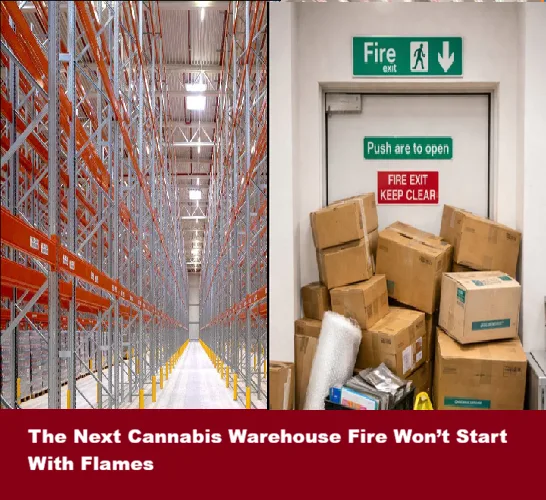
The Next Cannabis Warehouse Fire Won’t Start With Flames
It Will Start With an Operational Shortcut
Cannabis operators are scaling distribution, cultivation, storage, and finished-goods warehousing faster than ever.
More product. More packaging. Higher racks. Higher fuel loads.
And with that growth comes a quieter, often underestimated risk.
Most warehouse fires do not begin with a dramatic system failure. They begin with small operational decisions that slowly move the facility away from the conditions its fire protection systems were designed to handle.
That is where real exposure starts.
Why Cannabis Warehouses Carry Unique Fire Risk
Cannabis warehouses are not simple storage environments.
They often combine:
high-piled rack storage
plastic-heavy packaging materials
lithium battery-powered equipment
extraction-related materials (oils, solvents)
dense, high-value inventory
Each of these factors increases fire load and complexity.
More importantly, fire protection systems—especially sprinkler systems—are engineered based on specific assumptions about how materials are stored, classified, and arranged.
When operations evolve but those assumptions are not revisited, protection gaps begin to form.
And those gaps are rarely obvious.
How Fire Risk Quietly Increases Over Time
In many cannabis facilities, risk does not come from a single failure.
It develops gradually through operational drift.
A temporary change becomes permanent. Storage expands beyond original limits. New materials are introduced without review.
Nothing feels unsafe in the moment.
But over time, the facility begins operating outside the conditions its fire protection system was designed to protect.
That is when small issues become high-severity exposure.
The Most Common Operational Failures Behind Warehouse Fires
Across cannabis warehousing and distribution operations, the same patterns appear repeatedly.
1. Misclassified Commodities
As cannabis products evolve, so does packaging.
Plastic containers, multi-layer packaging, infused products, and new formats can significantly change fire behavior.
However, sprinkler systems are rarely re-evaluated when these changes occur.
What was once a lower-hazard storage profile may now behave like a higher-risk commodity class—without the fire protection system being adjusted accordingly.
2. Blocked Flue Spaces in Rack Storage
Flue spaces—the vertical and horizontal gaps between stored materials—are critical for fire protection.
They allow:
heat to rise
smoke to move
sprinkler water to penetrate effectively
When pallets are pushed tightly together to maximize space, these pathways disappear.
The result is reduced sprinkler effectiveness and faster fire spread through rack systems.
3. Exceeding Designed Storage Heights
As operations scale, increasing rack height is a common way to gain capacity.
But fire protection systems are designed with maximum storage heights in mind.
When those limits are exceeded without system upgrades:
sprinkler discharge may not reach the fire effectively
fire intensity may exceed suppression capacity
This creates one of the most common—and most dangerous—mismatches between operations and protection.
4. Poor Housekeeping and Storage Discipline
In fast-moving cannabis operations, temporary storage often becomes permanent.
Over time, this leads to:
blocked egress routes
obstructed sprinklers
inaccessible fire extinguishers
cluttered aisles
Housekeeping is often viewed as a cleanliness issue.
In reality, it is a core fire risk control.
5. Neglected Inspection and Maintenance
Fire protection systems are only effective when they are functional.
Yet many facilities overlook routine inspection and maintenance.
Common issues include:
closed or partially closed valves
disabled or untested fire pumps
damaged or unmaintained hydrants
outdated inspection records
These problems remain invisible—until a fire occurs.
At that point, they become critical failures.
What Makes Cannabis Warehouse Fires So Costly
Cannabis warehouses often store high-value, highly concentrated inventory.
A single fire can result in:
total product loss
facility shutdown
regulatory complications
supply chain disruption
long recovery timelines
In many cases, operations cannot resume quickly, especially where compliance, licensing, and reconstruction timelines are involved.
This makes fire risk not just a safety issue—but a business continuity issue.
What Actually Reduces Warehouse Fire Risk
The strongest cannabis operators do not treat fire protection as a one-time installation.
They treat it as an operational discipline that evolves with the business.
1. Ongoing Commodity Review
As products, packaging, and storage methods change, facilities should regularly reassess:
commodity classification
fire load
compatibility with existing systems
2. Rack Storage Discipline
Maintaining proper flue spaces and storage configurations is essential.
This requires:
clear storage guidelines
supervisor enforcement
regular inspection
3. Strict Storage Height Control
Posted storage height limits should not be treated as suggestions.
They are tied directly to system capability and should be:
clearly communicated
consistently enforced
reviewed during operational changes
4. Strong Housekeeping Programs
Effective housekeeping is not reactive.
It is structured, monitored, and enforced daily.
This includes:
clear aisles
controlled staging areas
unobstructed fire protection equipment
5. Reliable Inspection and Maintenance
Fire protection systems require consistent attention.
Facilities should ensure:
regular inspections
documented testing
immediate correction of deficiencies
Why Leadership and Culture Matter
In most cannabis operations, systems do not fail overnight.
They become less effective as operational discipline weakens.
That is why leadership plays a critical role.
Facilities that perform well over time:
reinforce standards daily
respond quickly to deviations
treat fire protection as part of operations—not separate from it
When safety is embedded into daily decision-making, risk stays controlled.
When it is treated as periodic compliance, risk begins to grow.
A Practical Perspective on Risk
The most dangerous warehouse fire risk is not equipment failure.
It is complacency.
It is the assumption that:
“this is how we’ve always done it”
“we’ve never had an issue before”
“we’ll address it later”
Those assumptions allow small gaps to accumulate.
And in high-value cannabis facilities, those gaps can lead to significant loss.
Final Takeaway
Cannabis warehouses are becoming critical infrastructure within the industry’s supply chain.
As operations scale, fire protection must scale with them.
When:
storage design
fire protection systems
operational discipline
remain aligned, facilities stay protected.
When they drift apart, risk increases quietly—until it becomes visible in the worst possible way.
For cannabis operators looking to strengthen warehouse fire protection strategy, improve storage discipline, and reduce catastrophic risk exposure, working with experienced risk advisors can help align operations with system design and long-term protection goals.