Many cannabis workers’ compensation claims are not random.
They come from repetitive tasks that were never redesigned. Workstations that were never adjusted. Lifting that was never coached. Housekeeping issues that were tolerated. Tools and equipment that were used without enough guarding, training, or supervision. Minor symptoms that were not reported until they became lost-time claims. Supervisors who were held accountable for output, but not for injury prevention.
That is why the strongest cannabis safety programs are not cosmetic. They are operational.
A real safety program does more than satisfy a compliance requirement or create a binder on a shelf. It helps reduce the number of injuries, reduce the severity of the injuries that still happen, improve reporting, support faster intervention, strengthen claim defensibility, and protect the long-term cost of workers’ compensation.
In a labor-intensive industry like cannabis, that is not a side benefit. It is a core business advantage.
For cannabis owners, COOs, CFOs, HR leaders, safety managers, and operations leaders, this is one of the most important workers’ compensation lessons to understand:
Safety programs reduce claims not just by preventing some injuries outright, but by improving how work is designed, how risks are identified, how supervisors respond, and how quickly problems are addressed before they become expensive.
Why Safety Programs Matter in Cannabis Operations
Cannabis businesses are often highly physical, highly regulated, and highly process-dependent.
Cultivation employees lift wet plants, move irrigation equipment, and work in repetitive postures. Trimmers and post-harvest teams perform repetitive fine-motor work for long stretches. Manufacturing employees may work around hot surfaces, sharp tools, repetitive packaging tasks, and production equipment. Warehouse and distribution teams handle product movement, storage, staging, and transport preparation. Dispensary staff stock product, stand for long periods, manage customer volume, and work in fast-paced retail environments where poor housekeeping and awkward lifting can still create claims.
That operating reality means workers’ compensation exposure is built into the workflow.
The question is whether the business manages that exposure with discipline or simply absorbs it as part of doing business.
Weak operators often think of safety as a compliance exercise. Better operators treat it as a system for reducing operational drag, preserving labor continuity, improving employee well-being, and controlling long-term insurance cost.
That distinction matters.
Because when a cannabis company has a weak safety program, injuries tend to occur more often, get reported later, get documented worse, and stay open longer.
When the safety program is stronger, the opposite tends to happen.
The Most Common Injury Drivers in Cannabis Businesses
The most common workers’ compensation claims in cannabis are often tied to familiar, preventable issues rather than freak events.
Repetitive Motion and Awkward Posture
This is especially common in trimming, post-harvest processing, packaging, and certain manufacturing functions.
Hand, wrist, shoulder, neck, and back complaints often develop gradually from repetitive hand motion, static positioning, poor ergonomics, and inadequate recovery time.
Strains and Sprains
Lifting, bending, carrying, pushing, pulling, and twisting remain major injury drivers in cultivation, warehouse, distribution, and retail settings.
Improper body mechanics, rushed movement, and poor task design make these claims more likely.
Slips, Trips, and Falls
Cannabis operations can create slip and trip exposure through wet floors, irrigation runoff, cluttered walkways, packaging debris, cords, uneven surfaces, poor drainage, or inadequate housekeeping.
These are often basic failures, but they still lead to real claims.
Cuts and Lacerations
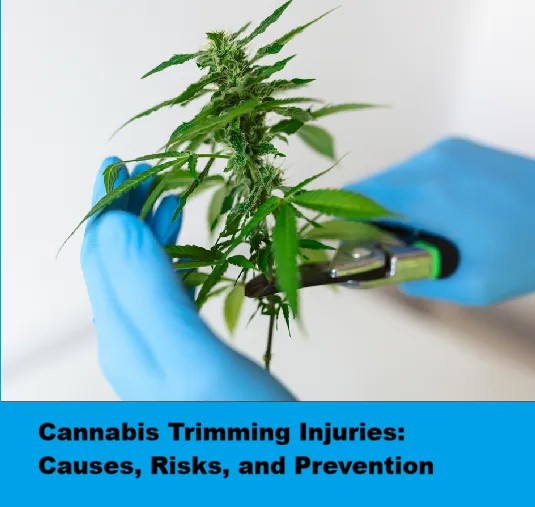
Trimming tools, knives, box cutters, packaging tools, and certain processing equipment can all create injury exposure when training, tool condition, guarding, or supervision is weak.
Machine and Equipment Interaction
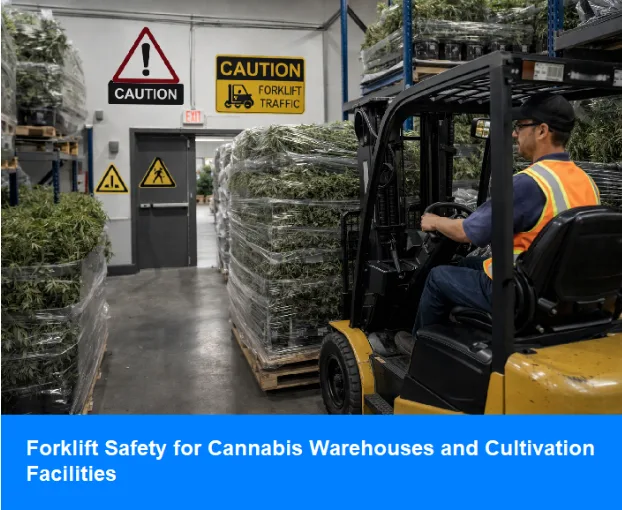
Manufacturing, processing, and packaging equipment can create pinch-point, caught-in, burn, and contact hazards if lockout practices, machine guarding, SOPs, or operator training are inconsistent.
Weak Supervision and Delayed Reporting
Many cannabis claims get worse because the early warning signs were ignored.
A sore wrist becomes a repetitive strain claim. A minor slip becomes a more serious event because no one corrected the underlying housekeeping issue. A light strain becomes lost time because the employee waited too long to report it and the supervisor failed to escalate it properly.
This is where safety programs earn their value.
How Safety Programs Reduce Claim Frequency and Severity
A good safety program reduces claim frequency by lowering the number of injuries that happen in the first place.
But it also reduces claim severity by influencing how serious injuries become when they do occur.
That distinction is critical.
If a cultivation team receives real lifting training, works in a better-designed environment, and uses more disciplined handling procedures, some strain claims may never occur. That is frequency reduction.
If a trimming supervisor is trained to recognize early repetitive strain complaints and escalate them quickly, a discomfort issue may be addressed before it becomes a more serious lost-time claim. That is severity reduction.
If a warehouse team has stronger housekeeping, clearer travel paths, daily inspections, and more consistent correction of floor hazards, slip-and-fall frequency may drop. If an incident still occurs, better documentation and faster response may reduce friction, improve treatment coordination, and limit downstream claim cost. That is both frequency and severity control.
Safety programs influence both sides of the equation.
That matters because workers’ compensation cost is shaped not just by how many claims a cannabis business has, but by how expensive those claims become.
Injury frequency, total incurred loss, claim duration, lost time, and claim severity all ultimately influence how the account performs over time. For many employers, that affects experience modification, pricing, underwriting perception, and the overall cost of risk.
What Practical Safety Controls Actually Work
The most effective cannabis safety programs are built into daily operations.
They are visible in how work is assigned, how supervisors are trained, how hazards are corrected, and how incidents are investigated.
Supervisor Engagement
This is one of the biggest differentiators.
Supervisors control pace, enforce housekeeping, observe body mechanics, respond to complaints, and set the tone for whether employees report problems early.
If front-line leaders are disengaged from safety, claims usually rise. If they are trained and held accountable, results often improve materially.
In cannabis, supervisor engagement should include daily observation, correction of unsafe behavior, attention to ergonomic strain, prompt escalation of injuries and near-misses, and reinforcement of safe work methods during busy production periods.
Ergonomics
Many cannabis injuries are tied to ergonomics, especially in trimming, post-harvest, packaging, and retail stocking tasks.
This is one of the most overlooked areas in cannabis workers’ compensation. Operators often focus on obvious hazards while underestimating the cumulative cost of repetitive motion and poor workstation design.
SOPs That Reflect Real Work
Safe operating procedures only help if they match actual workflows.
A generic SOP that does not reflect how employees really lift, cut, stock, clean, package, stage, or interact with machinery is not much use.
The best operators create SOPs that are specific, train to them, and verify that they are actually followed.
Inspections and Hazard Identification
Routine inspections catch the kinds of issues that drive everyday claims: blocked aisles, slippery areas, poor storage practices, damaged mats, awkward workstation setup, improper tool condition, machine guarding concerns, and inconsistent housekeeping.
Inspections matter most when they lead to correction.
A form without follow-up is not a safety program.
Housekeeping
Housekeeping sounds basic, but it remains one of the most direct ways to reduce claims in cultivation rooms, warehouses, packaging areas, loading zones, and dispensaries.
Wet surfaces, trim waste, packaging debris, cords, pallets, and cluttered work areas continue to drive preventable slip, trip, and fall exposure.
Good operators do not normalize these conditions.
Early Reporting
Early reporting is both a safety and claims issue.
Employees should understand that soreness, numbness, near-misses, strains, and minor incidents should be reported before they grow into larger problems.
This is especially important in repetitive-motion environments, where gradual discomfort is often dismissed until restrictions or lost time become unavoidable.
Incident Investigation
A real investigation should answer more than “what happened?”
It should ask:
What condition made this possible? What process failed? Was there a training gap? Was the pace unrealistic? Was the workstation poorly designed? Was supervision weak? Did prior warning signs exist?
In cannabis, incident investigation should focus on operational root causes, not just employee blame.
Documentation
Stronger documentation improves both prevention and defensibility.
Good documentation helps show what training was delivered, what inspections occurred, what hazards were corrected, what complaints were reported, what restrictions were received, and how management responded.
That supports internal learning, better claim coordination, and a stronger position if facts are later disputed.
Poor documentation, by contrast, often weakens both prevention and claim handling.
Not every workers’ compensation program is built with the same level of safety support, and that difference can materially affect claim outcomes over time.
For cannabis employers looking to reduce workers’ compensation claims more systematically, programs such as HISIG illustrate what stronger safety support can look like in practice. HISIG members have access to GotSafety resources that can help reinforce the day-to-day disciplines discussed above, including online safety training, training tracking, documentation tools, mobile access, and, where needed, discounted on-site safety support.
That matters because stronger safety performance rarely comes from good intentions alone. It usually comes from better systems, better follow-through, and better visibility into training, hazards, and corrective action.
For operators that are serious about reducing injuries and improving long-term workers’ compensation performance, that kind of loss prevention infrastructure can be a meaningful advantage.
Realistic Cannabis Claim Scenarios
Cultivation Strain Claim
A cultivation employee strains a lower back while moving irrigation equipment and lifting saturated pots during a reset.
The operation had no clear lifting protocol, no consistent use of team lifts, and no supervisor reinforcement around body mechanics during busy work cycles.
The injury results in medical treatment, work restrictions, and temporary productivity disruption.
A stronger safety program could have reduced the likelihood of the loss through better task design, lifting expectations, supervisor coaching, and pre-task planning.
Trimming Repetitive Motion Claim
A trimmer develops progressive wrist pain, forearm tightness, and shoulder discomfort after several weeks of long shifts in a poorly designed trimming station.
Breaks are inconsistent, task rotation is informal, and the supervisor treats soreness as normal. By the time the employee reports the issue, restrictions prevent trimming work and the claim becomes much more expensive.
A stronger safety program could have reduced both frequency and severity through ergonomic review, pacing discipline, supervisor awareness, and earlier reporting.
Warehouse Slip-and-Fall Claim
A warehouse employee slips on product debris near a staging area where housekeeping had been inconsistent for days.
The employee falls awkwardly, injures a knee, and misses work. Investigation reveals that floor conditions had been mentioned informally but never corrected.
This is not bad luck. It is a safety systems failure.
Manufacturing Cut or Machine Interaction Claim
A production employee suffers a hand laceration while interacting with packaging equipment and a cutting tool during a rushed production period.
Training had been rushed, the SOP did not reflect actual workflow, and supervision was focused almost entirely on throughput.
A stronger program could have improved guarding discipline, task clarity, training verification, and supervisor intervention before the loss occurred.
Dispensary Stocking and Housekeeping Claim
A dispensary employee strains a shoulder while repeatedly lifting and stocking product from an awkward storage setup in a back room.
In the same environment, clutter and poor organization create trip exposure for staff.
These may seem like minor retail issues, but they are recurring workers’ compensation drivers when not addressed systematically.
Common Weaknesses That Make Claims Worse
Cannabis businesses often make the same mistakes.
One is treating safety as paperwork instead of operations. Policies exist, but nobody uses them.
Another is failing to train supervisors as claims-control leaders. In many businesses, supervisors are central to injury prevention but receive very little practical safety coaching.
Another common weakness is weak ergonomics. Trimming rooms, packaging lines, retail back rooms, and warehouse workstations are often tolerated as-is for too long, even when employees show clear signs of strain.
Delayed reporting is another major problem. Employees keep working through discomfort, managers minimize symptoms, and what could have been addressed early becomes a more serious claim.
Weak incident investigation also keeps claims elevated. If the business never identifies root causes, the same loss patterns repeat.
And finally, poor documentation undermines both prevention and defensibility. If there is no reliable record of training, inspections, corrections, complaints, or response, the business is operating with unnecessary vulnerability.
How Stronger Safety Performance Improves Workers’ Compensation Results Over Time
The financial effect of safety discipline is not always immediate, but it is real.
When a cannabis business reduces injury frequency, it generally has fewer claims entering the workers’ compensation system.
When it reduces severity, claims tend to close faster, involve less lost time, and produce lower total incurred cost.
Over time, stronger results can improve loss runs, reduce operational disruption, support better experience modification outcomes where applicable, and improve how underwriters view the account.
Even when the insurance market remains difficult, cleaner safety performance gives an employer a stronger story to tell and more leverage than a business with recurring preventable losses.
This is why safety should be viewed as a business discipline, not a box-checking exercise.
It helps protect employees. It helps preserve operating continuity. It helps reduce claims friction. And it can materially affect long-term workers’ compensation cost.
Final Takeaway
Cannabis workers’ compensation claims are often more predictable than operators want to believe.
Repetitive motion, awkward posture, lifting strain, slips and falls, cuts, poor workstation design, weak housekeeping, machine hazards, and delayed reporting are not mysterious risks. They are recurring operational exposures.
The businesses that outperform on workers’ compensation usually do not get there through luck.
They get there through better supervision, stronger ergonomics, disciplined SOPs, active inspections, cleaner housekeeping, earlier reporting, better investigation, and stronger documentation.
In other words, the best safety programs reduce cannabis workers’ comp claims because they are embedded in the way the business actually runs.
That is better for employees, better for productivity, and better for long-term insurance performance.